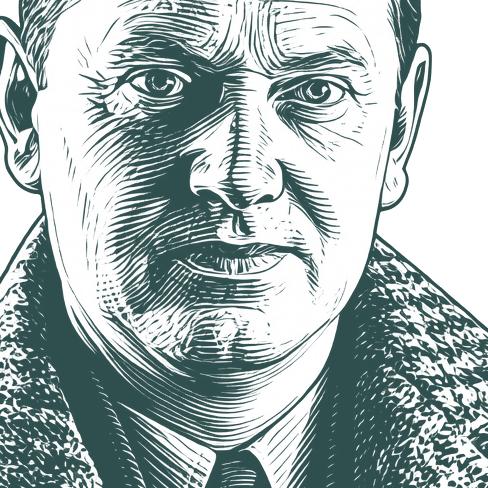
He had no wish to obliterate anything he had written, but he would dearly have liked to revise it, envying painters, who are allowed to return to the… - Evelyn Waugh
""
He had no wish to obliterate anything he had written, but he would dearly have liked to revise it, envying painters, who are allowed to return to the same theme time and time again, clarifying and enriching until they have done all they can with it. A novelist is condemned to provide a succession of novelties, new names for characters, new incidents for his plots, new scenery; but, Mr Pinfold maintained, most men harbour the germs of one or two books only; all else is professional trickery of which the most daemonic of the masters — Dickens and Balzac even — were flagrantly guilty.
Arthur Evelyn St. John Waugh (28 October 1903 – 10 April 1966) was an English writer of novels, biographies, and travel books; he was also a prolific journalist and book reviewer. His most famous works include the early satires Decline and Fall (1928) and A Handful of Dust (1934), the novel Brideshead Revisited (1945), and the Second World War trilogy Sword of Honour (1952–1961). He is recognised as one of the great prose stylists of the English language in the 20th century.
Biography information from
Wikiquote·
Portrait adapted from
Wikimedia Commons, Carl Van Vechten (1880–1964) (Public domain / CC0)
Also Known As
Alternative Names:
Evelyn Arthur St John Waugh
•
Arthur Evelyn St. John Waugh
What an immature, self-destructive, antiquated mischief is man! How obscure and gross his prancing and chattering on his little stage of evolution! How loathsome and beyond words boring all the thoughts and self-approval of his biological by-product! this half-formed, ill-conditioned body! this erratic, maladjusted mechanism of his soul: on one side the harmonious instincts and balanced responses of the animal, on the other the inflexible purpose of the engine, and between them man, equally alien from the being of Nature and the doing of the machine, the vile becoming!
There are always honourable exceptions in any general racial condemnation, and, heaven knows, the white people of the north have not made such a success of their own civilization that they can afford any extravagance of phrase. But it is not too much to say that in general character the descendants of the Negro slaves in the British Empire are a thriftless and dissolute lot. It is an unexpected development from the simple, woolly-headed, golden-hearted Bible-reading old darky that was held up as an example to European subscribers – the good old Uncle Tom who was to grow in the air of freedom into an educated, prudent and pious family man and citizen. The sugar plantations have been ruined or mechanized, and the Negroes, instead of following the example of the indentured coolies and becoming small proprietors, working long hours in the country, drift to the intermittent employment of the towns. They have proved quite unfit for retail trade: they are clumsy mechanics, a superstitious and excitable riff-raff hanging round the rum shops and staring listlessly at the Chinese, Madeiran and East Indian immigrants, who outstrip them in every branch of life. In Liberia, where they have been put in political power, they have erected a rigid racial bar between the immigrant and the aboriginal Negroes, and have introduced a system of forced labour more onerous than the slavery from which they were themselves freed.
Works in ChatGPT, Claude, or Any AI
Add semantic quote search to your AI assistant via MCP. One command setup.
Aunt Fanny tells me you made great friends with Mr. Mottram. I'm sure he can't be very nice.' 'I don't think he is,' said Julia. 'I don't know that I like nice people