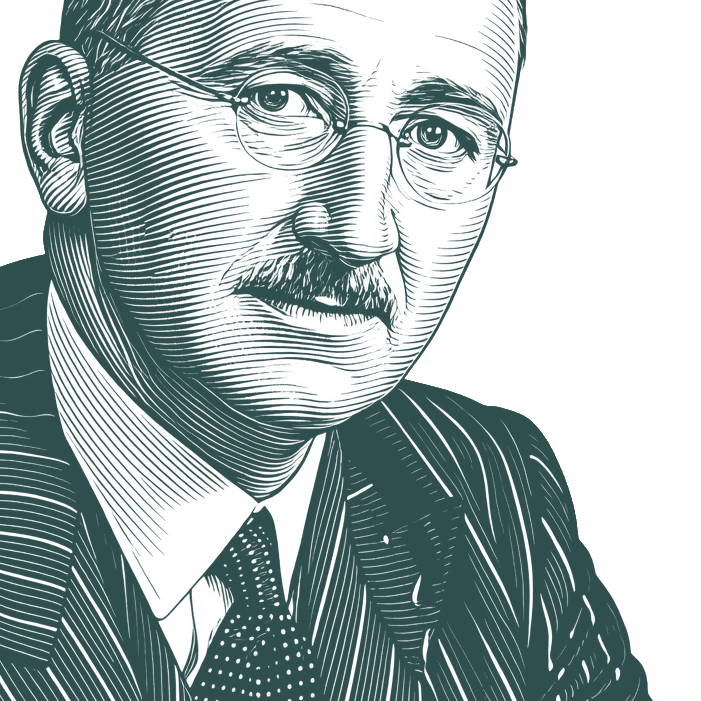
A reconsideration of the discussion in which I took an active part more than 40 years ago has left me with a rather depressing view of the somewhat s… - Friedrich Hayek
""
A reconsideration of the discussion in which I took an active part more than 40 years ago has left me with a rather depressing view of the somewhat shameful state of what has become an established part of economic science, the subject of 'economic systems'. It appears to me that in this subject political attractiveness has been preserved by the flimsiest of arguments. The kindest thing one can say is that some well-meaning people have allowed themselves to be deceived by the vague and thoughtless language commonly used by specialists in the theory of these issues.
Friedrich August von Hayek CH (8 May 1899 – 23 March 1992) was an Austrian, later British, economist and philosopher best known for his defense of classical liberalism. In 1974, Hayek shared the (with Gunnar Myrdal) for his "pioneering work in the theory of money and economic fluctuations and … penetrating analysis of the interdependence of economic, social and institutional phenomena". (Nobel Memorial Prize, 1974)
Portrait adapted from
Wikimedia Commons, The original uploader was DickClarkMises at English Wikipedia. (CC BY-SA)
Also Known As
Native Name:
Friedrich August von Hayek
Alternative Names:
Friedrich von Hayek
•
Friedrich A. von Hayek
•
Friedrich A. Von Hayek
•
F. A. von Hayek
•
Friedrich August Von Hayek
•
Hayek
•
F. A. Hayek
Portrait from Wikimedia Commons. Credit: The original uploader was DickClarkMises at English Wikipedia.. Used under CC BY-SA. Processed and styled by Quotewise.
Go Premium
Support Quotewise while enjoying an ad-free experience and premium features.
What all this amounts to, then, is that the Rule of Law requires that administrative discretion in coercive action (i.e., in interfering with the person and property of the private citizen) must always be subject to review by an independent court which is not an instrument of, or even privy to, the aims of current governmental policy; that its review must in all such instances extend to the substance of the administrative act and not merely to the question whether it was infra or ultra vires; and that, if such a court finds that the rights of private citizens have been infringed, it will assess damages just as if the right of this person had been violated by another private citizen. This, in addition to the familiar requirements of generality, equality, and certainty of the law is really the crux of the matter, the decisive point on which it depends whether the Rule of Law prevails or not.
The attack on economics sprang rather from a dislike of the application of scientific methods to the investigation of social problems. The existence of a body of reasoning which prevented people from following their first impulsive reactions, and which compelled them to balance indirect effects, which could be seen only by exercising the intellect, against intense feeling caused by the direct observation of concrete suffering, then as now, occasioned intense resentment.
Unlimited Quote Collections
Organize your favorite quotes without limits. Create themed collections for every occasion with Premium.
All the paradigms of culturally evolved institutions, morals, exchange, and money refer to such practices whose benefits transcend the individuals who practice them in the particular instances. The result is that whole groups may be helped by them to expand into what I shall call extended orders, through the effects of practices of which the individuals are not aware. Such practices can lead to the formation of orderly structures far exceeding the perception of those whose actions produce them. They make possible the adaptation of such actions to unknown circumstances and lead to the formation of an indefinitely expansible order which can develop only through group selection, that is, a selection of groups for common attributes possessed by them.