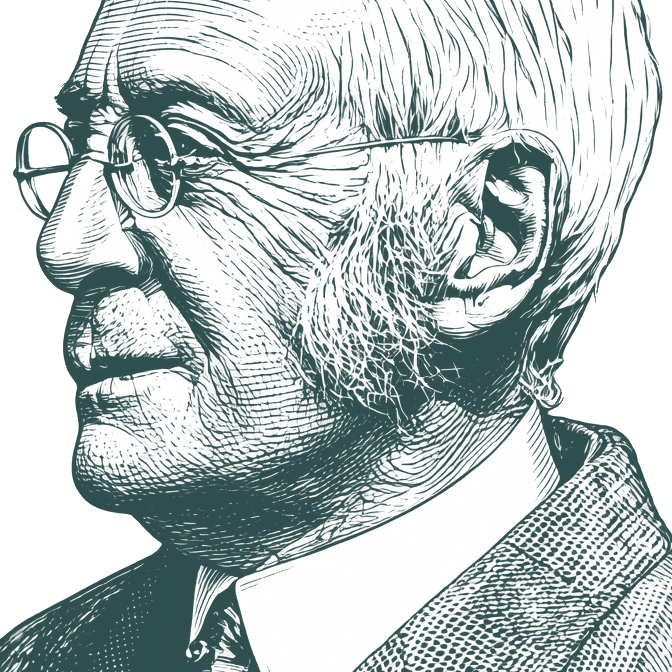
Old horse! old horse! what brought you here?” — “From Sacarap to Portland pier I’ve carted stone this many a year: Till, killed by blows and sore abu… - Charles William Eliot
""
Old horse! old horse! what brought you here?” — “From Sacarap to Portland pier I’ve carted stone this many a year: Till, killed by blows and sore abuse, They salted me down for sailors’ use The sailors they do me despise: They turn me over and damn my eyes; Cut off my meat, and pick my bones, And pitch the rest to Davy Jones.
English
Collect this quote
About
Charles William Eliot
Charles William Eliot (March 20, 1834 – August 22, 1926) was an American academic who served as Harvard University's president from 1869 until 1909.
Biography information from
Wikiquote·
Portrait adapted from
Wikimedia Commons, unknown. Original uploader was Ktsquare at en.wikipedia (Public domain / CC0)
Also Known As
Alternative Names:
Charles W. Eliot
•
Charles Eliot
Portrait from Wikimedia Commons. Credit: unknown. Original uploader was Ktsquare at en.wikipedia. Used under Public domain / CC0. Processed and styled by Quotewise.
Enhance Your Quote Experience
Enjoy ad-free browsing, unlimited collections, and advanced search features with Premium.
as we could tell by the washing of the water over our heads, and the heavy breaking of the seas against her bows, (with a sound as though she were striking against a rock,) only the thickness of the plank from our heads, as we lay in our berths, which are directly against the bows. At eight bells, the watch was called, and we came on deck, one hand going aft to take the wheel, and another going to the galley to get the grub for dinner. I stood on the forecastle, looking at the seas, which were rolling high, as far as the eye could reach, their tops white with foam, and the body of them of a deep indigo blue, reflecting the bright rays of the sun. Our ship rose slowly over a few of the largest of them, until one immense fellow came rolling on, threatening to cover her, and which I was sailor enough to know, by “the feeling of her” under my feet, she would not rise over. I sprang upon the knight-heads, and seizing hold of the fore-stay with my hands, drew myself upon it. My feet were just off the stanchion, when she struck fairly into the middle of the sea, and it washed her fore and aft, burying her in the water. As soon as she rose out of it, I looked aft, and everything forward of the main-mast, except the long-boat, which was griped and double-lashed down to the ring-bolts, was swept off clear. The galley, the pig-sty, the hen-coop, and a large sheep-pen which had been built upon the forehatch, were all gone, in the twinkling of an eye-leaving the deck as clean as a chin new reaped — and not a stick left, to show where they had stood. In the scuppers lay the galley, bottom up, and a few boards floating about, the wreck of the sheep-pen, — and half a dozen miserable sheep floating among them, wet through, and not a little frightened at the sudden change that had come upon them.
Love naturally begins in secresy because it begins in shyness; but it must live openly because it lives in joy. It is as when the leaves are changing; that which is to grow cannot conceal itself, and in every instance you see that all which is dry falls from the tree the moment the new leaves begin to sprout.
Go Premium
Support Quotewise while enjoying an ad-free experience and premium features.
It is in vain that a man of sound mind and cool temper understands the condition of such a wretched being, in vain he counsels him. He can no more communicate his own wisdom to him than a healthy man can instil his strength into the invalid by whose bedside he is seated.