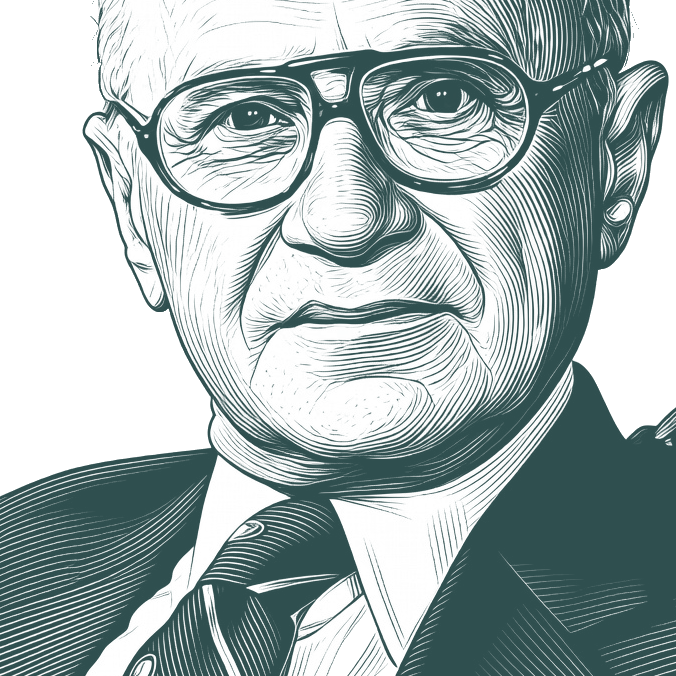
Milton Friedman (31 July 1912 – 16 November 2006) was an American economist noted for his support for free markets and a reduction in the size of government. In 1976 he was awarded a Nobel Prize in Economics.
Biography information from
Wikiquote·
Portrait adapted from
Wikimedia Commons, Bachrach Studios (Public domain / CC0)
Joan Robinson, a leading Keynesian and radical, produced a specimen for me to analyze. I said something like, "This is obviously the writing of a foreigner, so it's difficult for me to analyze. But I would say it is written by someone who had considerable artistic but not much intellectual talent." It turned out to be the handwriting of Lydia Lopokova, the world-famous Russian ballerina whom Keynes had married. That was surely my greatest triumph of the year at Cambridge!
Fair’ is in the eye of the beholder; ‘free’ is the verdict of the market. The word ‘free’ is used three times in the Declaration of Independence and once in the First Amendment to the Constitution, along with ‘freedom.’ The word ‘fair’ is not used in either of our founding documents.
Works in ChatGPT, Claude, or Any AI
Add semantic quote search to your AI assistant via MCP. One command setup.
We regard the minimum wage rate as one of the most, if not the most, antiblack laws on the statute books. The government first provides schools in which many young people, disproportionately black, are educated so poorly that they do not have the skills that would enable them to get good wages. It then penalizes them a second time by preventing them from offering to work for low wages as a means of inducing employers to give them on-the-job training. All this is in the name of helping the poor.