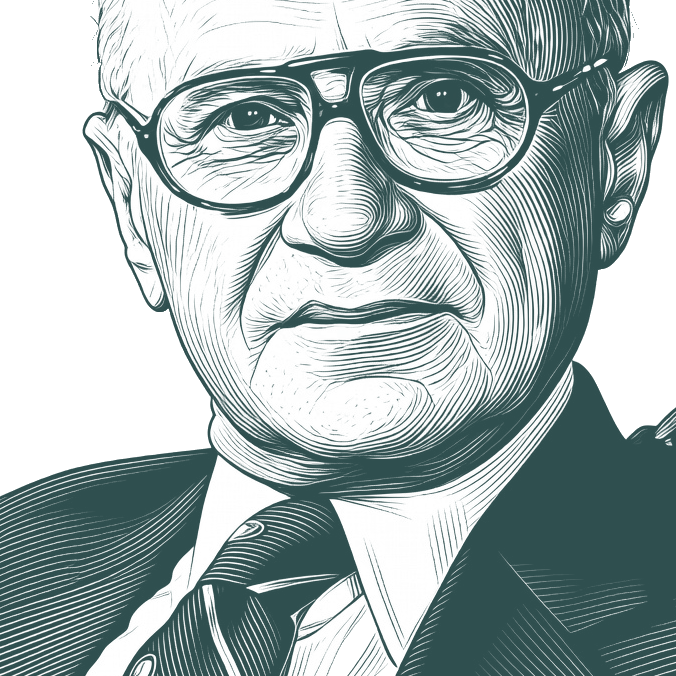
A society that puts equality before freedom will get neither. A society that puts freedom before equality will get a high degree of both. - Milton Friedman
""
A society that puts equality before freedom will get neither. A society that puts freedom before equality will get a high degree of both.
Milton Friedman (31 July 1912 – 16 November 2006) was an American economist noted for his support for free markets and a reduction in the size of government. In 1976 he was awarded a Nobel Prize in Economics.
Biography information from
Wikiquote·
Portrait adapted from
Wikimedia Commons, Bachrach Studios (Public domain / CC0)
The problem in this world is to avoid concentration of power - we must have a dispersion of power.
"Hardly any worker today engages in the kind of backbreaking labor that was common a century or so ago and that is still common over most of the globe. Working conditions are better; hours of work are shorter; vacations and other fringe benefits are taken for granted. Earnings are far higher, enabling the ordinary family to achieve a level of living that only the affluent few could earlier enjoy. If Gallup were to conduct a poll asking: "What accounts for the improvement in the lot of the worker?" the most popular answer would very likely be "labor unions," and the next, "government" — though perhaps "no one" or "don't know" or "no opinion" would beat both. Yet the history of the United States and other Western countries over the past two centuries demonstrates that these answers are wrong. During most of the period, unions were of little importance in the United States. As late as 1900, only 3 percent of all workers were members of unions. Even today fewer than one worker in four is a member of a union. Unions were clearly not a major reason for the improvement in the lot of the worker in the United States. Similarly, until the New Deal, regulation of and intervention in economic arrangements by government, and especially central government, were minimal. Government played an essential role by providing a framework for a free market. But direct government action was clearly not the reason for the improvement in the lot of the worker."
The Department of Health, Education and Welfare, established in 1953 to consolidate the scattered welfare programs, began with a budget of $2 billion, less than 5 percent of expenditures on national defense. Twenty-five years later, in 1978, its budget was $160 billion, one and a half times as much as total spending on the army, the navy, and the air force. It had the third largest budget in the world, exceeded only by the entire budget of the U.S. government and of the Soviet Union. The department supervised a huge empire, penetrating every corner of the nation. More than one out of every 100 persons employed in this country worked in the HEW empire, either directly for the department or in programs for which HEW had responsibility but which were administered by state or local government units. All of us were affected by its activities. (In late 1979, HEW was subdivided by the creation of a separate Department of Education.)