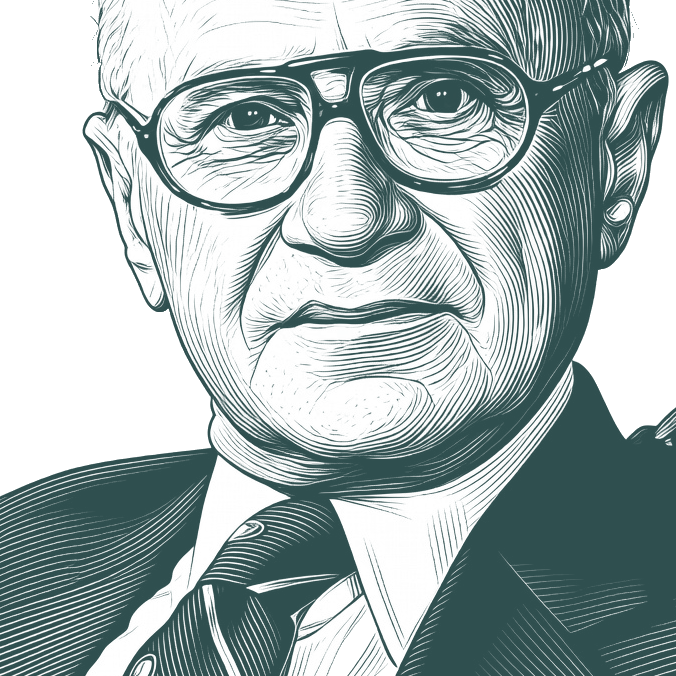
ان الشخص الوحيد الذي يمكنه اقناعك حقاً هو نفسك,عليك ان تدير الامور في رأسك اثناء استرخائك,ثم عليك ان تدرس الاراء الكثيرة المخالفة,دع الافكار تختمر في … - Milton Friedman
""
ان الشخص الوحيد الذي يمكنه اقناعك حقاً هو نفسك,عليك ان تدير الامور في رأسك اثناء استرخائك,ثم عليك ان تدرس الاراء الكثيرة المخالفة,دع الافكار تختمر في ذهنك,وبعد مدة طويلة حول تفضيلاتك إلى قناعات
Milton Friedman (31 July 1912 – 16 November 2006) was an American economist noted for his support for free markets and a reduction in the size of government. In 1976 he was awarded a Nobel Prize in Economics.
Biography information from
Wikiquote·
Portrait adapted from
Wikimedia Commons, Bachrach Studios (Public domain / CC0)
The second broad principle is that government power must be dispersed. If government is to exercise power, better in the county than in the state, better in the state than in Washington. If I do not like what my local community does, be it in sewage disposal, or zoning, or schools, I can move to another local community, and though few may take this step, the mere possibility acts as a check. If I do not like what my state does, I can move to another. If I do not like what Washington imposes, I have few alternatives in this world of jealous nations.
The view has been gaining widespread acceptance that corporate officials and labor leaders have a “social responsibility” that goes beyond serving the interest of their stockholders or their members. This view shows a fundamental misconception of the character and nature of a free economy. In such an economy, there is one and only one social responsibility of business — to use its resources and engage in activities designed to increase its profits so long as it stays within the rules of the game, which is to say, engages in open and free competition, without deception or fraud….It is the responsibility of the rest of us to establish a framework of law such that an individual in pursuing his own interest is, to quote Adam Smith again, “led by an invisible hand to promote an end which was no part of his intention. Nor is it always the worse for the society that it was no part of it. By pursuing his own interest, he frequently promotes that of the society more effectually than when he really intends to promote it. I have never known much good done by those who affected to trade for the public good.”
Few trends could so thoroughly undermine the very foundations of our free society as the acceptance by corporate officials of a social responsibility other than to make as much money for their stockholders as possible. This is a fundamentally subversive doctrine. If businessmen do have a social responsibility other than making maximum profits for stockholders, how are they to know what it is? Can self-selected private individuals decide what the social interest is? Can they decide how great a burden they are justified in placing on themselves or their stockholders to serve that social interest? Is it tolerable that these public functions of taxation, expenditure, and control be exercised by the people who happen at the moment to be in charge of particular enterprises, chosen for those posts by strictly private groups? If businessmen are civil servants rather than the emplo
Works in ChatGPT, Claude, or Any AI
Add semantic quote search to your AI assistant via MCP. One command setup.
At the end of World War II, we had wage and price controls. Under wartime inflationary conditions, many employers found it difficult to recruit employees. To get around the limitations of wage control, many began to offer health care as a fringe benefit to attract workers. As a new benefit, it took some years for the Internal Revenue Service to get around to requiring the cost of the medical care to be included in the reported taxable income of the employees. By the time it did, workers had come to regard nontaxable medical care provided by the employer as a right — or should I say entitlement? They raised such a big political fuss that Congress legislated nontaxable status for employer-provided medical care.