When I attempted, a few minutes ago, to describe our spiritual longings, I was omitting one of their most curious characteristics. We usually notice … - C. S. Lewis
""
When I attempted, a few minutes ago, to describe our spiritual longings, I was omitting one of their most curious characteristics. We usually notice it just as the moment of vision dies away, as the music ends or as the landscape loses the celestial light. What we feel then has been well described by Keats as “the journey homeward to habitual self.” You know what I mean. For a few minutes we have had the illusion of belonging to that world. Now we wake to find that it is no such thing. We have been mere spectators. Beauty has smiled, but not to welcome us; her face was turned in our direction, but not to see us. We have not been accepted, welcomed, or taken into the dance. We may go when we please, we may stay if we can: “Nobody marks us.” A scientist may reply that since most of the things we call beautiful are inanimate, it is not very surprising that they take no notice of us. That, of course, is true. It is not the physical objects that I am speaking of, but that indescribable something of which they become for a moment the messengers. And part of the bitterness which mixes with the sweetness of that message is due to the fact that it so seldom seems to be a message intended for us but rather something we have overheard. By bitterness I mean pain, not resentment. We should hardly dare to ask that any notice be taken of ourselves. But we pine. The sense that in this universe we are treated as strangers, the longing to be acknowledged, to meet with some response, to bridge some chasm that yawns between us and reality, is part of our inconsolable secret. And surely, from this point of view, the promise of glory, in the sense described, becomes highly relevant to our deep desire. For glory meant good report with God, acceptance by God, response, acknowledgment, and welcome into the heart of things. The door on which we have been knocking all our lives will open at last.
Clive Staples Lewis (29 November 1898 – 22 November 1963) was an Irish author, scholar of medieval literature, and Christian apologist. He is best known for his essays on Christianity and for the children's fantasy series The Chronicles of Narnia.
Biography information from
Wikiquote·
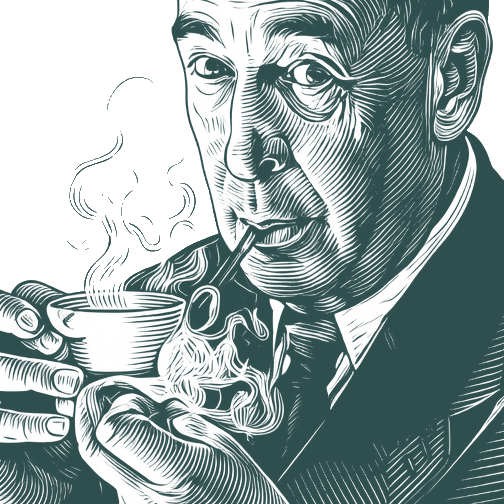
Portrait adapted from
Wikimedia Commons, John S. Murray (Public domain / CC0)
Also Known As
Pen Names:
N. W. Clerk
•
Clive Hamilton
Birth Name:
Clive Staples Lewis
Alternative Names:
CS Lewis
•
C.S. Lewis
•
Clive Lewis
•
Nat Whilk
None of the children knew who Aslan was any more than you do; but the moment the Beaver had spoken these words everyone felt quite different. Perhaps it has sometimes happened to you in a dream that someone says something which you don't understand but in the dream it feels as if it had some enormous meaning — either a terrifying one which turns the whole dream into a nightmare or else a lovely meaning too lovely to put into words, which makes the dream so beautiful that you remember it all your life and are always wishing you could get into that dream again. It was like that now. At the name of Aslan each one of the children felt something jump in it's inside. Edmund felt a sensation of mysterious horror. Peter felt suddenly brave and adventurous. Susan felt as if some delicious smell or some delightful strain of music had just floated by her. And Lucy got the feeling you have when you wake up in the morning and realize that it is the beginning of the holidays or the beginning of Summer.
And Peter became a tall and deep-chested man and a great warrior, and he was called King Peter the Magnificent. And Susan grew into a tall and gracious woman with black hair that fell almost to her feet and the kings of the countries beyond the sea began to send ambassadors asking for her hand in marriage. And she was called Queen Susan the Gentle. Edmund was a graver and quieter man than Peter, and great in council and judgment. he was called King Edmund the Just. But as for Lucy, she was always gay and golden-haired, and all princes in those parts desired her to be their Queen, and her own people called her Queen Lucy the Valiant.
PREMIUM FEATURE
Advanced Search Filters
Filter search results by source, date, and more with our premium search tools.
There are no ordinary people. You have never talked to a mere mortal. Nations, cultures, arts, civilizations - these are mortal, and their life is to ours as the life of a gnat. But it is immortals whom we joke with, work with, marry, snub and exploit - immortal horrors or everlasting splendors. This does not mean that we are to be perpetually solemn. We must play. But our merriment must be of that kind (and it is, in fact, the merriest kind) which exists between people who have, from the outset, taken each other seriously - no flippancy, no superiority, no presumption.