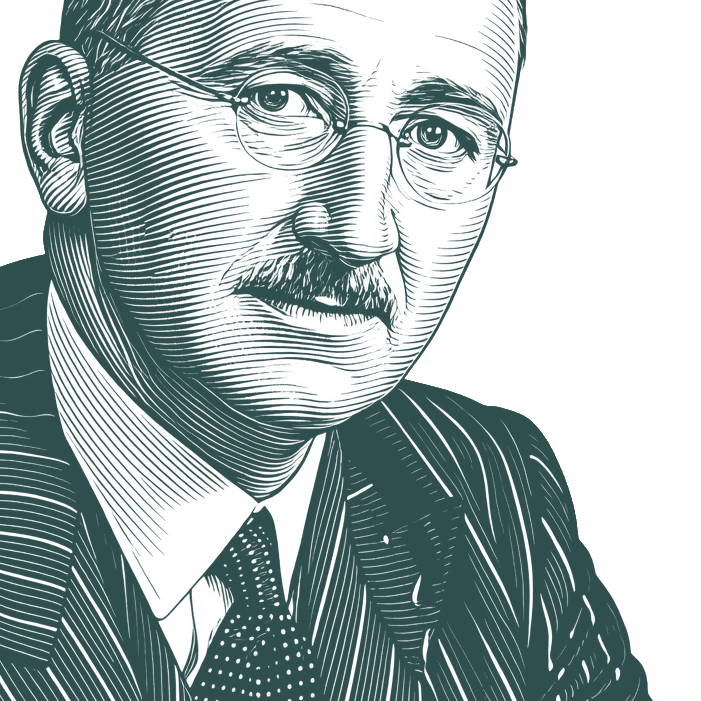
Our whole modern society, based on a far-ranging division of labour, is, however, essentially dependent on two factors that conflict with our natural… - Friedrich Hayek
""
Our whole modern society, based on a far-ranging division of labour, is, however, essentially dependent on two factors that conflict with our natural instincts. The first is the assumption, implicit but not understood, that we can do more good to unknown people if we follow the impersonal signals of the market, which enable us to serve the needs of people whom we do not know and to make use of opportunities and facilities with which we have no direct acquaintance. The second is that for this purpose we can follow our own individual aims with freely chosen associates and are not bound to serve the concrete ends of the group into which we were born.
English
Collect this quote
About
Friedrich Hayek
Friedrich August von Hayek CH (8 May 1899 – 23 March 1992) was an Austrian, later British, economist and philosopher best known for his defense of classical liberalism. In 1974, Hayek shared the (with Gunnar Myrdal) for his "pioneering work in the theory of money and economic fluctuations and … penetrating analysis of the interdependence of economic, social and institutional phenomena". (Nobel Memorial Prize, 1974)
Portrait adapted from
Wikimedia Commons, The original uploader was DickClarkMises at English Wikipedia. (CC BY-SA)
Also Known As
Native Name:
Friedrich August von Hayek
Alternative Names:
Friedrich von Hayek
•
Friedrich A. von Hayek
•
Friedrich A. Von Hayek
•
F. A. von Hayek
•
Friedrich August Von Hayek
•
Hayek
•
F. A. Hayek
The advice I would give is: If you have the courage to do so, don't feel patriotic in monetary matters. Choose the money which helps you best.
I am now profoundly convinced of what I had only hinted at before, namely, that the struggle between the advocates of a free society and the advocates of the socialist system is not a moral but an intellectual conflict. Thus socialists have been led by a very peculiar development to revive certain primitive instincts and feelings which in the course of hundreds of years had been practically suppressed by commercial or mercantile morals, which by the middle of the last century had come to govern the world economy.
I don't know what monetarism is. If monetarism just means a good old-fashioned quantity theory, of course it has not failed. If it means the particular version of Milton Friedman, I think it has because he imagines that he can achieve — ascertain — a clear quantity relationship between a measurable quantity of money and the price level. I don't think that is possible. In fact, just about 40 years ago in the opening sentences of my book, Prices and Production, I wrote that it would be a great misfortune if people ever cease to believe in the quantity theory of money. It would be even worse ever to believe it literally. And that's exactly what Milton Friedman does.