The next time I met Ludwig Wittgenstein was in the spring of 1928 when the economist Dennis Robertson, who was taking me for a walk through the Fello… - Friedrich Hayek
""
The next time I met Ludwig Wittgenstein was in the spring of 1928 when the economist Dennis Robertson, who was taking me for a walk through the Fellows' Gardens of Trinity College, Cambridge, suddenly decided to change course because on the top of a little rise he perceived the form of the philosopher draped over a deckchair. He evidently stood rather in awe of him, and he did not wish to disturb him.
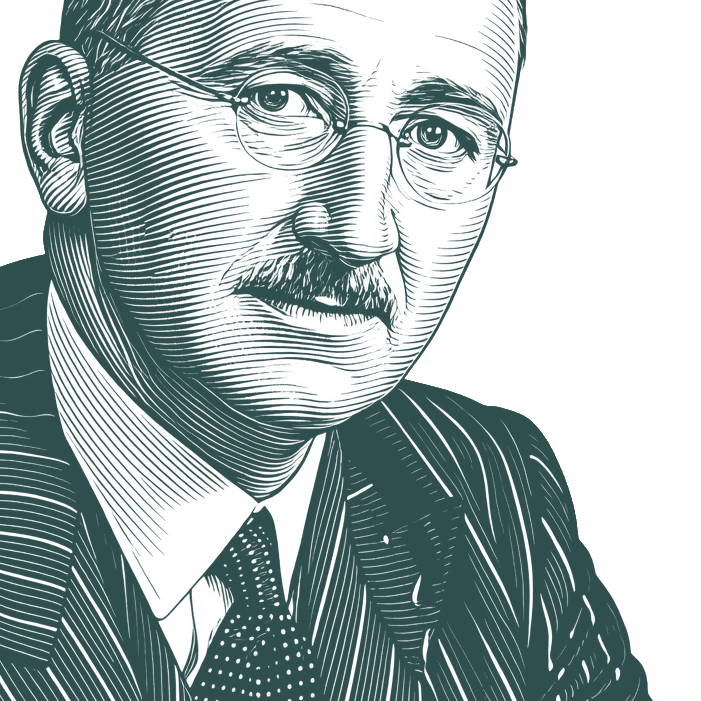
Friedrich August von Hayek CH (8 May 1899 – 23 March 1992) was an Austrian, later British, economist and philosopher best known for his defense of classical liberalism. In 1974, Hayek shared the (with Gunnar Myrdal) for his "pioneering work in the theory of money and economic fluctuations and … penetrating analysis of the interdependence of economic, social and institutional phenomena". (Nobel Memorial Prize, 1974)
Portrait adapted from
Wikimedia Commons, The original uploader was DickClarkMises at English Wikipedia. (CC BY-SA)
Also Known As
Native Name:
Friedrich August von Hayek
Alternative Names:
Friedrich von Hayek
•
Friedrich A. von Hayek
•
Friedrich A. Von Hayek
•
F. A. von Hayek
•
Friedrich August Von Hayek
•
Hayek
•
F. A. Hayek
Portrait from Wikimedia Commons. Credit: The original uploader was DickClarkMises at English Wikipedia.. Used under CC BY-SA. Processed and styled by Quotewise.
Unlimited Quote Collections
Organize your favorite quotes without limits. Create themed collections for every occasion with Premium.
Since the value of freedom rests on the opportunities it provides for unforeseen and unpredictable actions, we will rarely know what we lose through a particular restriction of freedom.
I suggested before that the whole of economic history could be rewritten in terms of this gradual suppression of the primitive instincts by what we very mistakenly call “artificial” rules. Of course, they are not in the strict sense artificial. Nobody ever invented them. They were not the result of design. The new manners of conduct were not adopted because anybody thought they were better. They were adopted because somebody who acted on them profited from it and his group gained from it, and so these rules, without anybody under standing them—that is very important for the later part of my argument—without anybody understanding in what way they benefited their community, gradually came to be generally accepted.
Unlimited Quote Collections
Organize your favorite quotes without limits. Create themed collections for every occasion with Premium.
The social sciences building at the University of Chicago indeed still bears since it was built 40 years ago on its outside an inscription taken from the famous physicist Lord Kelvin: "When you cannot measure, your knowledge is meager and unsatisfactory." I will admit that that may be true, but it is certainly not scientific to insist on measurement where you don't know what your measurements mean. There are cases where measurements are not relevant. What has done much damage to microeconomics is striving for a pseudo-exactness by imitating methods of the physical sciences which have to deal with what are fundamentally much more simple phenomena. And the assumption that it is possible to ascertain all the relevant particular facts still completely dominates the alternative methods of dealing with our constitutional ignorance, which economists have tried to overcome. This of course, is what has come to be called macroeconomics as distinct from microeconomics.