at the outset almost every man is frightened when he goes into action, but that the course to follow is for the man to keep such a grip on himself th… - Theodore Roosevelt
""
at the outset almost every man is frightened when he goes into action, but that the course to follow is for the man to keep such a grip on himself that he can act just as if he was not frightened. After this is kept up long enough it changes from pretense to reality, and the man does in very fact become fearless by sheer dint of practicing fearlessness when he does not feel it.
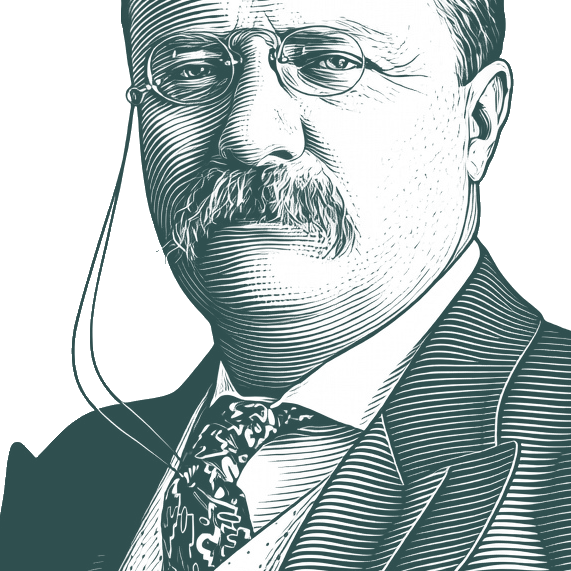
Theodore Roosevelt, Jr. (27 October 1858 – 6 January 1919), also known as T.R. or Teddy, was an American statesman, author, explorer, soldier, naturalist, and reformer who served as the 26th president of the United States from 1901 to 1909. As a leader of the Republican Party during this time, he became a driving force for the Progressive Era in the United States in the early 20th century.
Biography information from
Wikiquote·
Portrait adapted from
Wikimedia Commons, Adam Cuerden (Public domain / CC0)
Also Known As
Birth Name:
Theodore Roosevelt Jr.
Also Known As:Teddy
Alternative Names:
Teddy Roosevelt
•
Theodore Roosevelt, Jr.
•
T. Roosevelt
•
T. Roosevelt, Jr.
•
T. R.
There must be the keenest sense of duty, and with it must go the joy of living; there must be shame at the thought of shirking the hard work of the world, and at the same time delight in the many-sided beauty of life
A number of the heads of the offices were slippery politicians of a low moral grade, themselves appointed under the spoils system, and anxious, directly or indirectly, to break down the merit system and to pay their own political debts by appointing their henchmen and supporters to the positions under them. Occasionally these men acted with open and naked brutality. Ordinarily they sought by cunning to evade the law.
PREMIUM FEATURE
Advanced Search Filters
Filter search results by source, date, and more with our premium search tools.
The people as a whole can be benefited morally and materially by a system which shall permit of ample reward for exceptional efficiency, but which shall nevertheless secure to the average man, who does his work faithfully and well, the reward to which he is entitled. Remember that I speak only of the man who does his work faithfully and well. The man who shirks his work, who is lazy or vicious, or even merely incompetent, deserves scant consideration; we may be sorry for his family, but it is folly to waste sympathy on the man himself; and it is also folly for sentimentalists to try to shift the burden of blame from such a man himself to “society” and it is an outrage to give him the reward given to his hard-working, upright, and efficient brother. Still less should we waste sympathy on the criminal; there are altogether too many honest men who need it; and one chief point in dealing with the criminal should be to make him understand that he will be in personal peril if he becomes a lawbreaker. I realize entirely that in the last analysis, with the nation as with the individual, it is private character that counts for most. It is because of this realization that I gladly lay myself open to the charge that I preach too much, and dwell too much upon moral commonplaces; for though I believe with all my heart in the nationalization of this Nation—in the collective use on behalf of the American people of the governmental powers which can be derived only from the American people as a whole—yet I believe even more in the practical application by the individual of those great fundamental moralities.