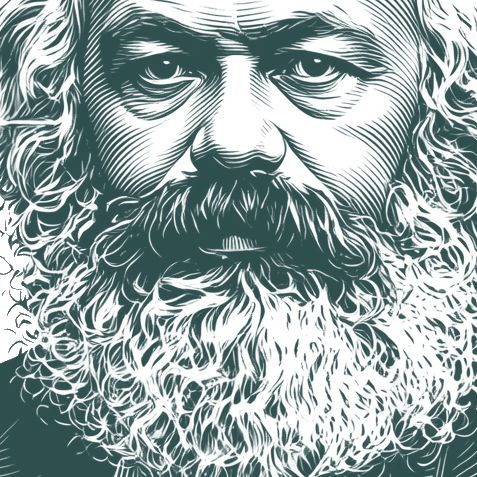
The less you eat, drink, buy books, go to the theatre or to balls, or to the pub, and the less you think, love, theorize, sing, paint, fence, etc., t… - Karl Marx
""
The less you eat, drink, buy books, go to the theatre or to balls, or to the pub, and the less you think, love, theorize, sing, paint, fence, etc., the more you will be able to save and the greater will become your treasure which neither moth nor rust will corrupt — your capital. The less you are, the less you express your life, the more you have, the greater is your alienated life and the greater is the saving of your alienated being.
Karl Heinrich Marx (5 May 1818 – 14 March 1883) was a German political philosopher, economist, historian, sociologist, journalist and revolutionary socialist. Marx's work in economics laid the basis for labor theory of value, and has influenced much of subsequent economic thought. He published many works during his lifetime, including The Communist Manifesto (1848) and the first volume of Das Kapital (1867), the two later volumes being completed by his collaborator Friedrich Engels.
Biography information from
Wikiquote·
Portrait adapted from
Wikimedia Commons, John Jabez Edwin Mayall (Public domain / CC0)
Also Known As
Pen Names:
Glückskind
Alternative Names:
Karl Heinrich Marx
•
Karl H. Marx
•
Marx
Related quotes. More quotes will automatically load as you scroll down, or you can use the load more buttons.
Shorter versions of this quote
The less you eat, drink and read books; the less you go to the theatre, the dance hall, the public house; the less you think, love, theorize, sing, paint, fence, etc., the more you save-the greater becomes your treasure which neither moths nor dust will devour-your capital. The less you are, the more you have; the less you express your own life, the greater is your alienated life-the greater is the store of your estranged being.
Since the working-class lives from hand to mouth,it buys as long as it has the means to buy.
These contradictions, of course, lead to explosions, crises, in which momentary suspension of all labour and annihilation of a great part of the capital violently lead it back to the point where it is enabled [to go on] fully employing its productive powers without committing suicide. Yet, these regularly recurring catastrophes lead to their repetition on a higher scale, and finally to its violent overthrow. There are moments in the developed movement of capital which delay this movement other than by crises; such as e.g. the constant devaluation of a part of the existing capital: the transformation of a great part of capital into fixed capital which does not serve as agency of direct production; unproductive waste of a great portion of capital etc.
Works in ChatGPT, Claude, or Any AI
Add semantic quote search to your AI assistant via MCP. One command setup.