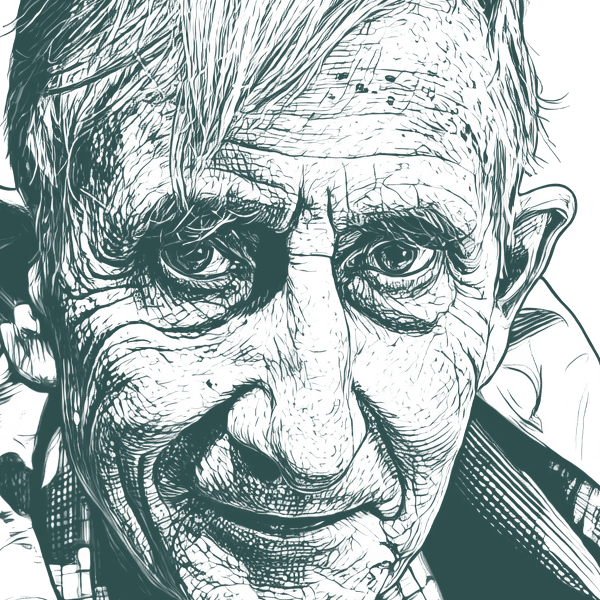
Freeman John Dyson (15 December 1923 – 28 February 2020) was an English-born American physicist, mathematician, and futurist, famous for his work in quantum mechanics, nuclear weapons design and policy, and the search for extraterrestrial intelligence. He was the winner of the Templeton Prize in the year 2000.
Human desires and inlitu- tions decide how we use them.
I had the good luck a few years ago to visit the archeological site of Zippori in Israel ... I could see here displayed the Greek culture that Jesus decisively rejected, the same Greek culture that infiltrated the Christian religion soon after his death and has dominated Christianity ever since.
Works in ChatGPT, Claude, or Any AI
Add semantic quote search to your AI assistant via MCP. One command setup.
Starting from Einstein's theory of general relativity, Oppenheimer and Snyder found solutions... that described what happens to a massive star when it has exhausted its supplies of nuclear energy. The star collapses gravitationally and disappears from the visible universe, leaving behind only an intense gravitational field to mark its presence. The star remains in a state of permanent free fall, collapsing endlessly inward into the gravitational pit without ever reaching the bottom. ... In my opinion, the black hole is incomparably the most exciting and the most important consequence of general relativity. But Einstein ... was actively hostile to the idea of black holes. ... Oddly enough, Oppenheimer too in later life was uninterested in black holes, although... they were his most important contribution to science. ... Oppenheimer in his later years believed that the only problem worthy of attention of a serious theoretical physicist was the discovery of fundamental equations of physics. Einstein certainly felt the same way.