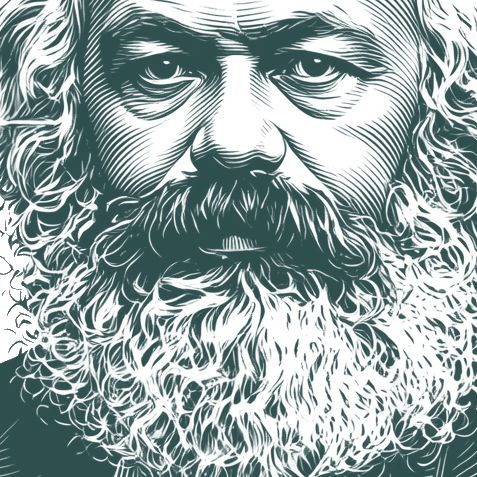
Karl Heinrich Marx (5 May 1818 – 14 March 1883) was a German political philosopher, economist, historian, sociologist, journalist and revolutionary socialist. Marx's work in economics laid the basis for labor theory of value, and has influenced much of subsequent economic thought. He published many works during his lifetime, including The Communist Manifesto (1848) and the first volume of Das Kapital (1867), the two later volumes being completed by his collaborator Friedrich Engels.
Biography information from
Wikiquote·
Portrait adapted from
Wikimedia Commons, John Jabez Edwin Mayall (Public domain / CC0)
Also Known As
Pen Names:
Glückskind
Alternative Names:
Karl Heinrich Marx
•
Karl H. Marx
•
Marx
"A use-value, or useful article, therefore, has value only because abstract human labour is objectified or materialized in it. How, then, is the magnitude of value to be measured? By means of the quantity of the "value-forming substance", the labour, contained in the article. This quantity is measured by its duration, and the labour-time is itself measured on the particular scale of hours, days etc."
A commodity appears, at first sight, a very trivial thing, and easily understood. Its analysis shows that it is, in reality, a very queer thing, abounding in metaphysical subtleties and theological niceties.
Enhance Your Quote Experience
Enjoy ad-free browsing, unlimited collections, and advanced search features with Premium.
If money is the bond binding me to human life, binding society to me, connecting me with nature and man, is not money the bond of all bonds? Can it not dissolve and bind all ties? Is it not, therefore, also the universal agent of separation?