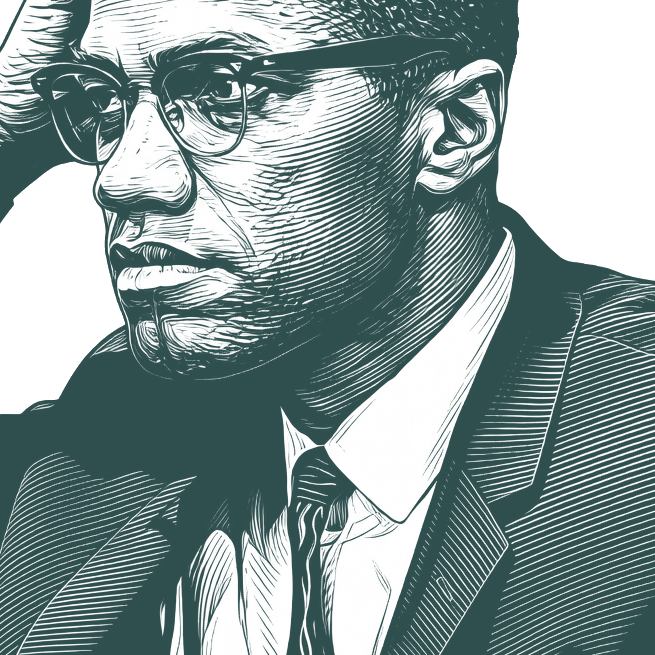
I'm for truth, no matter who tells it. I'm for justice, no matter who it is for or against. I'm a human being, first and foremost, and as such I'm fo… - Malcolm X
""
I'm for truth, no matter who tells it. I'm for justice, no matter who it is for or against. I'm a human being, first and foremost, and as such I'm for whoever and whatever benefits humanity as a whole.
El-Hajj Malik El-Shabazz, or Malcolm X, born Malcolm Little (19 May 1925 – 21 February 1965) was an American Muslim minister and a human rights activist. For many years, he was a major proponent of the Nation of Islam, espousing black supremacy, the separation of black and white Americans, and scoffing at the civil rights movement's emphasis on racial integration. By March 1964, he had grown disillusioned with the Nation of Islam and ultimately repudiated its teachings, embracing Sunni Islam; while continuing to emphasize Pan-Africanism, black self-determination, and black self-defense, disavowing racism. In February 1965, he was assassinated by three men, all of whom were affiliated with the Nation of Islam. The Autobiography of Malcolm X, published shortly after his death, is considered one of the most influential non-fiction books of the 20th century.
Biography information from
Wikiquote·
Portrait adapted from
Wikimedia Commons, Marion S. Trikosko (Public domain / CC0)
Also Known As
Pen Names:
Malachi Shabazz
Birth Name:
Malcolm Little
Alternative Names:
El-Hajj Malik El-Shabazz
•
Malcolm Shabazz
•
Malik El-Shabazz
يجب ان نتعلم من الاطفال عدم الخجل من الفشل و ان نقوم و نعيد الكرة
And now you're facing a situation where the young Negro's coming up. They don't want to hear that "turn the-other-cheek" stuff, no. In Jacksonville, those were teenagers, they were throwing Molotov cocktails. Negroes have never done that before. But it shows you there's a new deal coming in. There's new thinking coming in. There's new strategy coming in. It'll be Molotov cocktails this month, hand grenades next month, and something else next month. It'll be ballots, or it'll be bullets. It'll be liberty, or it will be death. The only difference about this kind of death—it'll be reciprocal.
PREMIUM FEATURE
Advanced Search Filters
Filter search results by source, date, and more with our premium search tools.
Usually, when people are sad, they don't do anything. They just cry over their condition. But when they get angry, they bring about a change. When they get angry, they aren't interested in logic, aren't interested in odds, aren't interested in consequences. When they get angry, they realize the condition that they're in- that their suffering is unjust... and that anything they do to correct it... they're justified.