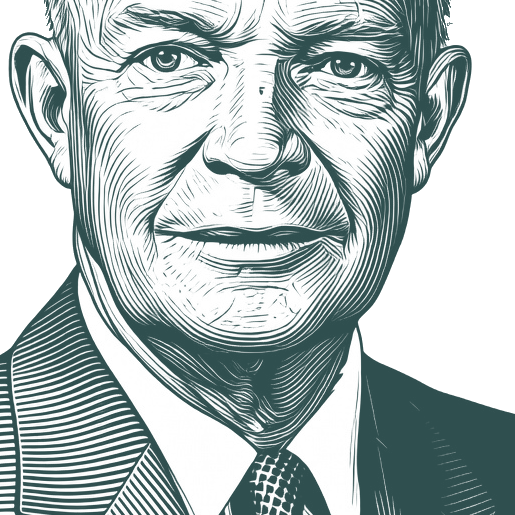
I well knew that Patton delighted to startle his hearers with fantastic statements; many men who believed they knew him well never penetrated past th… - Dwight D. Eisenhower
""
I well knew that Patton delighted to startle his hearers with fantastic statements; many men who believed they knew him well never penetrated past the shell of showmanship in which he constantly and carefully clothed himself. But he was essentially a shrewd battle leader who invariably gained the devotion of his subordinates. From early life his one ambition was to be a successful battlefield commander. Because of this he was an inveterate reader of military history and his heroes were the great captains of past ages.
Dwight David Eisenhower (14 October 1890 – 28 March 1969), also widely known by his nickname "Ike", was an American military officer and statesman who served as the 34th president of the United States from 1953 to 1961. During World War II, he served as Supreme Commander of the Allied Expeditionary Force in Europe, and achieved the rare five-star rank of General of the Army. He was responsible for planning and supervising the invasion of North Africa in Operation Torch in 1942–1943 and the successful invasion of Normandy in 1944–1945 from the Western Front.
Biography information from
Wikiquote·
Portrait adapted from
Wikimedia Commons, White House (Public domain / CC0)
Also Known As
Birth Name:
David Dwight Eisenhower
Also Known As:Ike
Alternative Names:
Dwight David Eisenhower
•
President Eisenhower
•
D. Eisenhower
•
Eisenhower
•
Dwight David "Ike" Eisenhower
•
Dwight Eisenhower
•
Ike Eisenhower
In preparing for battle I have always found that plans are useless, but planning is indispensable.
Our Mediterranean experiences had reaffirmed the truth that unity, co-ordination, and co-operation are the keys to successful operations. War is waged in three elements but there is no separate land, air, or naval war. Unless all assets in all elements are efficiently combined and co-ordinated against a properly selected, common objective, their maximum potential power cannot be realized. Physical targets may be separated by the breadth of a continent or an ocean, but their destruction must contribute in maximum degree to the furtherance of the combined plan of operation. That is what co-ordination means.
The visual evidence and the verbal testimony of starvation, cruelty and bestiality were so overpowering as to leave me a bit sick. In one room, where they [there] were piled up twenty or thirty naked men, killed by starvation, George Patton would not even enter. He said that he would get sick if he did so. I made the visit [to Gotha] deliberately, in order to be in a position to give first-hand evidence of these things if ever, in the future, there develops a tendency to charge these allegations merely to "propaganda."