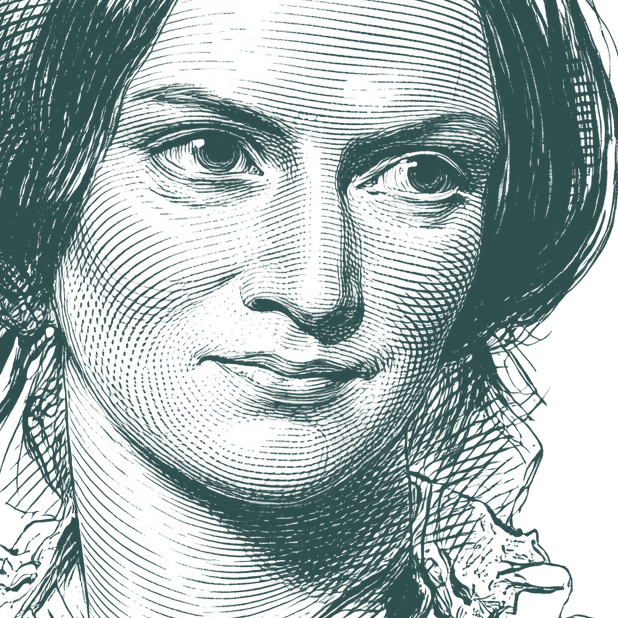
Where my soul went during that swoon I cannot tell. Whatever she saw, or wherever she travelled in her trance on that strange night she kept her own … - Charlotte Brontë
""
Where my soul went during that swoon I cannot tell. Whatever she saw, or wherever she travelled in her trance on that strange night she kept her own secret; never whispering a word to Memory, and baffling imagination by an indissoluble silence. She may have gone upward, and come in sight of her eternal home, hoping for leave to rest now, and deeming that her painful union with matter was at last dissolved. While she so deemed, an angel may have warned her away from heaven's threshold, and, guiding her weeping down, have bound her, once more, all shuddering and unwilling, to that poor frame, cold and wasted, of whose companionship she was grown more than weary.
I know she re-entered her prison with pain, with reluctance, with a moan and a long shiver. The divorced mates, Spirit and Substance, were hard to re-unite: they greeted each other, not in an embrace, but a racking sort of struggle.
Charlotte Brontë (21 April 1816 – 31 March 1855) was an English novelist, the eldest of the three Brontë sisters, who first published her work under the pseudonym Currer Bell.
Biography information from
Wikiquote·
Portrait adapted from
Wikimedia Commons, George Richmond (Public domain / CC0)
Also Known As
Alternative Names:
Tree
•
Florian Wellesley
•
Lord Charles Albert
•
Captain Tree
•
Charles Wellesley
•
Charlotte Bronte
•
Currer Bell
•
Karlotta Bronte
•
Douro
•
Mrs. A. B. Nicholls
•
Charlotte Nicholls
•
Sharlotta Bronte
•
Mrs. Arthur Bell NichollsMrs. Arthur Bell Nicholls
"One morning I fell to sketching a face: what sort of a face it was to be, I did not care or know. I took a soft black pencil, gave it a broad point, and worked away. Soon I had traced on the paper a broad and prominent forehead and a square lower outline of visage: that contour gave me pleasure; my fingers proceeded actively to fill it with features. Strongly-marked horizontal eyebrows must be traced under that brow; then followed, naturally, a well-defined nose, with a straight ridge and full nostrils; then a flexible-looking mouth, by no means narrow; then a firm chin, with a decided cleft down the middle of it: of course, some black whiskers were wanted, and some jetty hair, tufted on the temples, and waved above the forehead. Now for the eyes: I had left them to the last, because they required the most careful working. I drew them large; I shaped them well: the eyelashes I traced long and sombre; the irids lustrous and large. "Good! but not quite the thing," I thought, as I surveyed the effect: "they want more force and spirit;" and I wrought the shades blacker, that the lights might flash more brilliantly — a happy touch or two secured success. There, I had a friend's face under my gaze; and what did it signify that those young ladies turned their backs on me? I looked at it; I smiled at the speaking likeness: I was absorbed and content.
Is that a portrait of some one you know?" asked Eliza, who had approached me unnoticed. I responded that it was merely a fancy head, and hurried it beneath the other sheets. Of course, I lied: it was, in fact, a very faithful representation of Mr. Rochester. But what was that to her, or to any one but myself? Georgiana also advanced to look. The other drawings pleased her much, but she called that 'an ugly man.
Even for me life had its gleams of sunshine.
Try QuoteGPT
Chat naturally about what you need. Each answer links back to real quotes with citations.
Take my love. One day share my life. Be my dearest, first on earth.