All economic activity is carried out through time. Every individual economic process occupies a certain time, and all linkages between economic proce… - Friedrich Hayek
""
All economic activity is carried out through time. Every individual economic process occupies a certain time, and all linkages between economic processes necessarily involve longer or shorter periods of time.
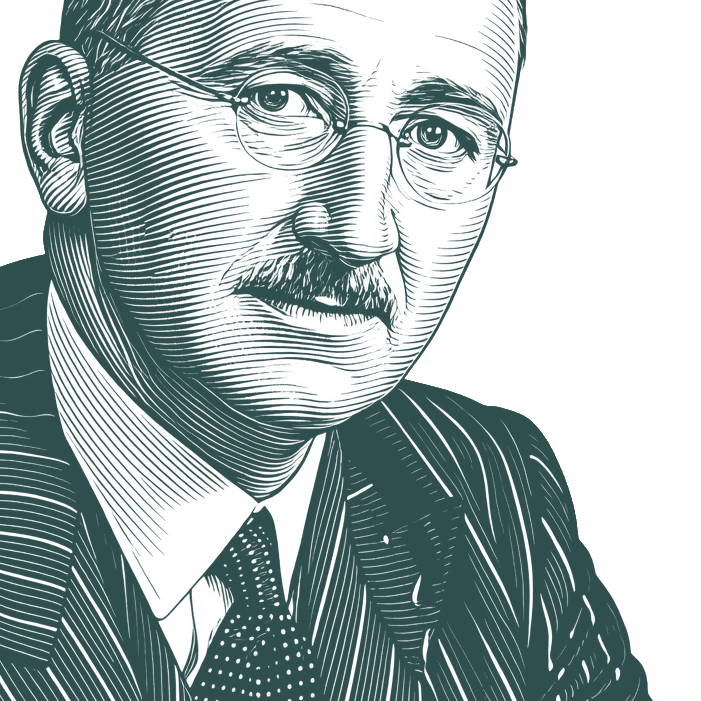
Friedrich August von Hayek CH (8 May 1899 – 23 March 1992) was an Austrian, later British, economist and philosopher best known for his defense of classical liberalism. In 1974, Hayek shared the (with Gunnar Myrdal) for his "pioneering work in the theory of money and economic fluctuations and … penetrating analysis of the interdependence of economic, social and institutional phenomena". (Nobel Memorial Prize, 1974)
Portrait adapted from
Wikimedia Commons, The original uploader was DickClarkMises at English Wikipedia. (CC BY-SA)
Also Known As
Native Name:
Friedrich August von Hayek
Alternative Names:
Friedrich von Hayek
•
Friedrich A. von Hayek
•
Friedrich A. Von Hayek
•
F. A. von Hayek
•
Friedrich August Von Hayek
•
Hayek
•
F. A. Hayek
Portrait from Wikimedia Commons. Credit: The original uploader was DickClarkMises at English Wikipedia.. Used under CC BY-SA. Processed and styled by Quotewise.
Enhance Your Quote Experience
Enjoy ad-free browsing, unlimited collections, and advanced search features with Premium.
The socialist argument continues despite its many defeats―on the impossibility of economic calculation under collectivism, the fallacious claims for the use of markets under socialism, the incompatibility of liberty and state direction of the economy, and many others. The argument is being won by the new liberals of the late 20th century. But many people still do not understand it. And most on the Left continue to resist it.
I've always doubted that the socialists had a leg to stand on intellectually. They have improved their argument somehow, but once you begin to understand that prices are an instrument of communication and guidance which embody more information than we directly have, the whole idea that you can bring about the same order based on the division of labor by simple direction falls to the ground. Similarly, the idea [that] you can arrange for distributions of incomes which correspond to some conception of merit or need. If you need prices, including the prices of labor, to direct people to go where they are needed, you cannot have another distribution except the one from the market principle. I think that intellectually there is just nothing left of socialism.
I mean, it became particularly acute because Keynes, against his intentions, had stimulated the development of macroeconomics. And I was convinced that not only his particular conclusions, but the whole foundation of macroeconomics was wrong. So I wanted to demonstrate that we had to return to microeconomics, that this whole prejudice supported by the natural scientists that could deduce anything from measurable magnitudes, the effects of aggregates and averages, came to fascinate me much more. I felt in a way, that the thing which I am now prepared to do, I don’t know as there’s anybody else who can do this particular task. And I rather hoped that what I had done in capital theory would be continued by others. This was a new opening which was much more fascinating. The other would have meant working for a result which I already knew, but had to prove it. Which was very dull. The other thing was an open problem: How does economics really look like when you recognize it as the prototype of a new kind of science of complex phenomena which could not employ the simple model of mechanics or physics, but had to deal with what then I described as mere pattern predictions, certain limited prediction. That was so much more fascinating as an intellectual problem.