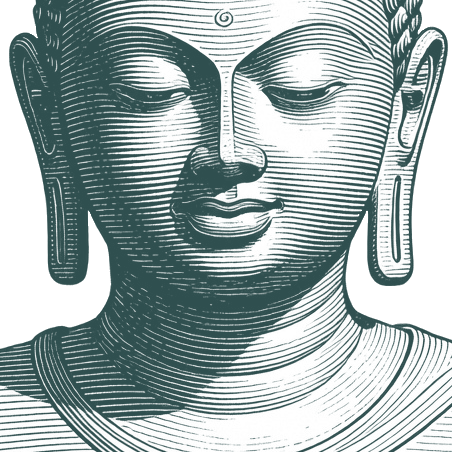
Siddhārtha Gautama (Sanskrit/Devanagari: सिद्धार्थ गौतम Siddhārtha Gautama, c. 563/624 – c. 483/544 BCE) or Siddhattha Gotama in Pali,; also called the Gautama Buddha, the Shakyamuni Buddha ("Buddha, Sage of the Shakyas") or simply the Buddha, after the title of Buddha, was a monk (śramaṇa), mendicant, sage, philosopher, teacher and religious leader on whose teachings Buddhism was founded. He is believed to have lived and taught mostly in the northeastern part of ancient India sometime between the 6th and 4th centuries BCE.
Biography information from
Wikiquote·
Portrait adapted from
Wikimedia Commons, พระมหาเทวประภาส วชิรญาณเมธี (ผู้ถ่าย-ปล่อยสัญญาอนุญาตภาพให้นำไปใช้ได้เพื่อการศึกษาโดยอยู่ภา่ยใต้ cc-by-sa-3.0) ผู้สร้างสรรค์ผลงาน/ส่งข้อมูลเก็บในคลังข้อมูลเสรีวิกิมีเดียคอมมอนส์ - เทวประภาส มากคล้าย (CC BY-SA)
Also Known As
Alternative Names:
Buddha
•
Bhagwan Buddha
•
Prabudha
•
Munish
•
Lord Buddha
•
Sakya-muni
•
Shakyasimha
•
Devarajalu
•
Buddhadeva
•
Sakyasinha
•
Tathagata Buddha
•
Trigyesh
•
Siddhartha Gautama
•
Shakyamuni
•
Sakyamuni
•
Sugata
•
Fo
•
Shakyamuni Buddha
•
Khajit
•
Trigya
•
Mahatma Buddha
•
Gotama Buddha
•
Padmayani
•
Lokapradīpa
•
Gautama Buddha
•
Gautam Buddha
Portrait from Wikimedia Commons. Credit: พระมหาเทวประภาส วชิรญาณเมธี (ผู้ถ่าย-ปล่อยสัญญาอนุญาตภาพให้นำไปใช้ได้เพื่อการศึกษาโดยอยู่ภา่ยใต้ cc-by-sa-3.0) ผู้สร้างสรรค์ผลงาน/ส่งข้อมูลเก็บในคลังข้อมูลเสรีวิกิมีเดียคอมมอนส์ - เทวประภาส มากคล้าย. Used under CC BY-SA. Processed and styled by Quotewise.
Enhance Your Quote Experience
Enjoy ad-free browsing, unlimited collections, and advanced search features with Premium.
All that we are is the result of what we have thought.
Learn this from water: loud splashes the brook but the oceans depth are calm.
"THE FOUR NOBLE TRUTHS
I. Suffering does exist.
II. Suffering arises from "attachment" to desires.
III. Suffering ceases when "attachment" to desire ceases.
IV. Freedom from suffering is possible by practicing the eightfold path:
1. Right understanding (view). 2. Right intention (thought). 3. Right speach. 4. Right action. 5. Right livelihood. 6. Right effort. 7. Right mindfulness. 8. Rght meditation (concentration).
Buddha's fourfold consolation:
With a mind free from greed and unfriendliness, incorruptible, and purified, the noble disciple is already during this lifetime assure of a fourfold consolation:
“If there is another world (heaven), and a cause and effect (Karma) of good and bad actions, then it may be that, at the dissolution of the body, after death, I shall be reborn in a happy realm, a heavenly world.” Of this first consolation (s)he is assured.
“And if there is no other world, no reward and no punishment of good and bad actions, then I live at least here, in this world, an untroubled and happy life, free from hate and unfriendliness.” Of this second consolation (s)he is assured.
“And if bad things happen to bad people, but I do not do anything bad (or have unfriendliness against anyone), how can I, who am doing no bad things, meet with bad things?” Of this third consolation (s)he is assured.
“And if no bad things happen to bad people, then I know myself in both ways pure.” Of this fourth consolation (s)he is assured."