It is quite remarkable how quickly conventional wisdom on this issue has changed. Just over two decades ago, in September 2000, corporate America and… - Bernie Sanders
""
It is quite remarkable how quickly conventional wisdom on this issue has changed. Just over two decades ago, in September 2000, corporate America and the leadership of both political parties strongly supported granting China “permanent normal trade relations” status, or PNTR. At that time, the U.S. Chamber of Commerce, the National Association of Manufacturers, the corporate media, and virtually every establishment foreign policy pundit in Washington insisted that PNTR was necessary to keep U.S. companies competitive by giving them access to China’s growing market, and that the liberalization of China’s economy would be accompanied by the liberalization of China’s government with regard to democracy and human rights. This position was seen as obviously and unassailably correct. Granting PNTR, the economist Nicholas Lardy of the centrist Brookings Institution argued in the spring of 2000, would "provide an important boost to China’s leadership, that is taking significant economic and political risks in order to meet the demands of the international community for substantial additional economic reforms." The denial of PNTR, on the other hand, "would mean that U.S. companies would not benefit from the most important commitments China has made to become a member" of the World Trade Organization (WTO). Writing around the same time, the political scientist Norman Ornstein of the conservative American Enterprise Institute put it more bluntly. “American trade with China is a good thing, for America and for the expansion of freedom in China,” he asserted.:“That seems, or should seem, obvious." Well, it wasn’t obvious to me, which is why I helped lead the opposition to that disastrous trade agreement. What I knew then, and what many working people knew, was that allowing American companies to move to China and hire workers there at starvation wages would spur a race to the bottom, resulting in the loss of good-paying union jobs in the United States and lower wages for American workers. And that’s exactly what happened. In the roughly two decades that followed, around two million American jobs were lost, more than 40,000 factories shut down, and American workers experienced wage stagnation—even while corporations made billions and executives were richly rewarded. In 2016, Donald Trump won the presidential election in part by campaigning against U.S. trade policies, tapping into the real economic struggles of many voters with his phony and divisive populism.
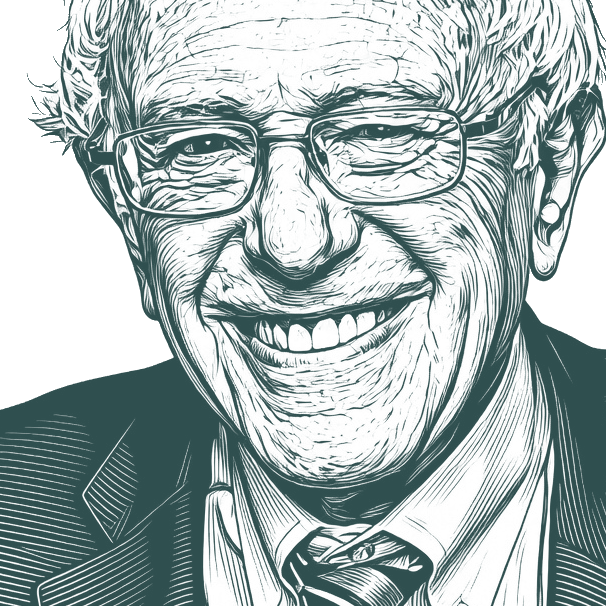
Bernard Sanders (born September 8, 1941) is an American politician who has served as the junior from Vermont since 2007. The for the state's at-large congressional district from 1991 to 2007, he is the longest-serving independent in U.S. congressional history and a member of the Democratic caucus. Sanders ran unsuccessfully for the 2016 and 2020 Democratic nomination for president.
Portrait adapted from
Wikimedia Commons, Palácio do Planalto from Brasilia, Brasil (CC BY)
Also Known As
Birth Name:
Bernard Sanders
Alternative Names:
Sen. Bernie Sanders
•
Bernie
•
Bernard "Bernie" Sanders
•
Senator Bernie Sanders
•
Senator Sanders
I think we're making some progress, but everybody knows that for decades now, not just under Biden, not just under Trump, but for decades now, what we have seen in America is an economy in which the very, very wealthy are doing phenomenally well while working families are struggling. Today, Bob, we don't talk about it much, we have more income and wealth inequality than we have ever had in the history of the United States. This is way before Biden. But what we're seeing now is 60 percent of our people living paycheck to paycheck, we have a health care system which is totally broken, we pay the highest prices in the world for prescription drugs. We've got 18 million households, where people are spending 50 percent of their income trying to pay the rent or pay a mortgage. So, we have some structural problems in America. The Biden administration has made some progress, we have got a long way to go. And what the Democratic Party has got to do is have the guts to take on corporate greed, which is unprecedented, all over the economy. The people who own the large corporations have enjoyed record breaking profits, we got to create an economy that works for all, not just a few.
Last year, Secretary Hillary Clinton and I agreed upon the need for a Unity Reform Commission to move the party in a new and more democratic direction. In a few weeks, this group will have its final meeting in Washington, D.C., and will decide if we are going to move forward in an inclusive way or continue with the current failed approach. This is not some abstract, insular debate. The future of Democratic Party institutions has everything to do with whether or not Democrats have the grass-roots energy to effectively take on Trump, the Republican Party and their reactionary agenda—or whether we remain in the minority. What are some of the reforms that are desperately needed? First, it is absurd that the Democratic Party now gives over 700 superdelegates—almost one-third the number a presidential candidate needs to win the nomination—the power to control the nominating process and ignore the will of voters. Second, in contrast to Republicans, Democrats believe in making voting easier, not harder. We believe in universal and same-day voter registration and ending antiquated, arbitrary and discriminatory voter registration laws. These same principles must apply to our primaries. Our job must be to reach out to independents and to young people and bring them into the Democratic Party process. Independent voters are critical to general election victories. Locking them out of primaries is a pathway to failure. In that regard, it is absurd that New Yorkers must change their party registration six months before the Democratic primary in order to participate. Other states have similar, if not as onerous provisions. Third, in states that use caucuses, we must make it easier for working people and students to participate. While there is much to be said for bringing people together, face to face to discuss why they support the candidate of their choice, not everybody is able to participate because of work, child care or other obligations. A process must be developed that gives everyone the right to cast a vote even if they are not physically able to attend a caucus. Finally, if we are to succeed, we must fully appreciate Brazile’s revelations and understand the need for far more transparency in the financial and policy workings of the Democratic Party. Hundreds of millions of dollars flow in and out of the Democratic National Committee with little to no accountability. That simply is not acceptable.
The problem has been that for some people in the liberal – and I consider myself a progressive and not a liberal for that reason alone. You can be 100% in support of the civil rights movement, for criminal justice reform, for comprehensive immigration reform, for women’s rights, for protecting the environment and being extraordinarily aggressive in transforming our energy system from fossil fuel to sustainable energy and at the same time be a champion of white workers and black workers and Latino workers and immigrant workers – there should not be a dichotomy. But what has happened is that for many people in the Democratic party they said, ‘Well, I believe in women’s rights, I believe in civil rights, I believe in immigration reform, criminal justice reform,’ and that has been the emphasis at the expense of the needs of a shrinking middle class and massive levels of income and wealth inequality. The truth is we can and should do both, it’s not an either, or it is both.