Well, I hate to admit it, but it is possible that there is (one) such a thing as telepathy and (two) that the CETI project's idea that we might commu… - Philip K. Dick
""
Well, I hate to admit it, but it is possible that there is (one) such a thing as telepathy and (two) that the CETI project's idea that we might communicate with extraterrestrial beings via telepathy is possibly a reasonable idea — if telepathy exists and if ETIs exist. Otherwise we are trying to communicate with someone who doesn't exist with a system which doesn't work.
Philip Kindred Dick (16 December 1928 – 2 March 1982) was an American writer, whose published works mainly belong to the genre of science fiction. Dick explored philosophical, sociological and political themes in novels with plots dominated by monopolistic corporations, authoritarian governments, and altered states of consciousness. In his later works, Dick's thematic focus tended to reflect his personal interest in metaphysics and theology.
Biography information from
Wikiquote·
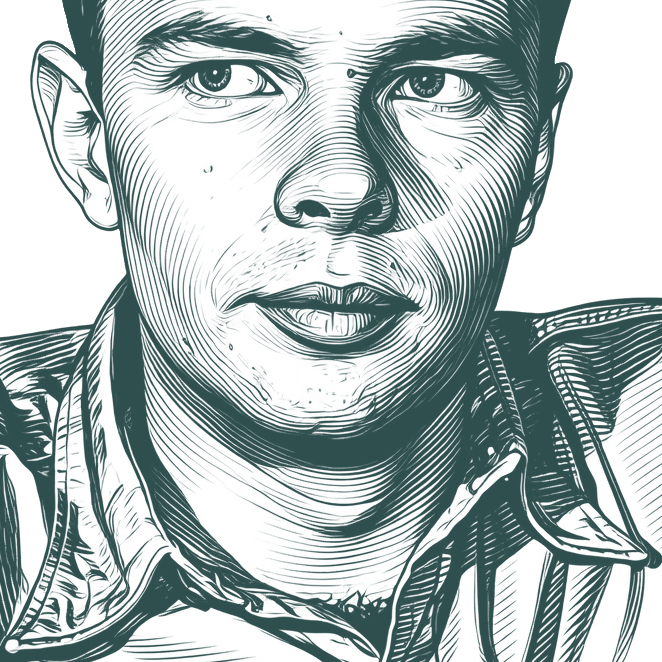
Portrait adapted from
Wikimedia Commons, Arthur Knight (photographer) (Public domain / CC0)
Also Known As
Pen Names:
Richard Phillipps
•
Jack Dowland
Birth Name:
Philip Kindred Dick
Also Known As:Phil
Alternative Names:
PKD
•
Philip Dick
•
Richard Phillips
•
Filip K. Dik
Madness, he thought. The ultimate horror for our paranoid culture: vicious unseen mechanical entities that flit at the edges of our vision, that can go anywhere, that are in our very midst.
I've always told people that for each person there is a sentence — a series of words — which has the power to destroy him. When Fat told me about Leon Stone I realized (this came years after the first realization) that another sentence exists, another series of words, which will heal the person. If you're lucky you will get the second; but you can be certain of getting the first: that is the way it works.
Go Premium
Support Quotewise while enjoying an ad-free experience and premium features.
These creatures are among us, although morphologically they do not differ from us; we must not posit a difference of essence, but a difference of behavior. In my science fiction I write about about them constantly. Sometimes they themselves do not know they are androids. Like Rachel Rosen, they can be pretty but somehow lack something; or, like Pris in We Can Build You, they can be absolutely born of a human womb and even design androids — the Abraham Lincoln one in that book — and themselves be without warmth; they then fall within the clinical entity "schizoid," which means lacking proper feeling. I am sure we mean the same thing here, with the emphasis on the word "thing." A human being without the proper empathy or feeling is the same as an android built so as to lack it, either by design or mistake. We mean, basically, someone who does not care about the fate which his fellow living creatures fall victim to; he stands detached, a spectator, acting out by his indifference John Donne's theorem that "No man is an island," but giving that theorem a twist: that which is a mental and a moral island is not a man.