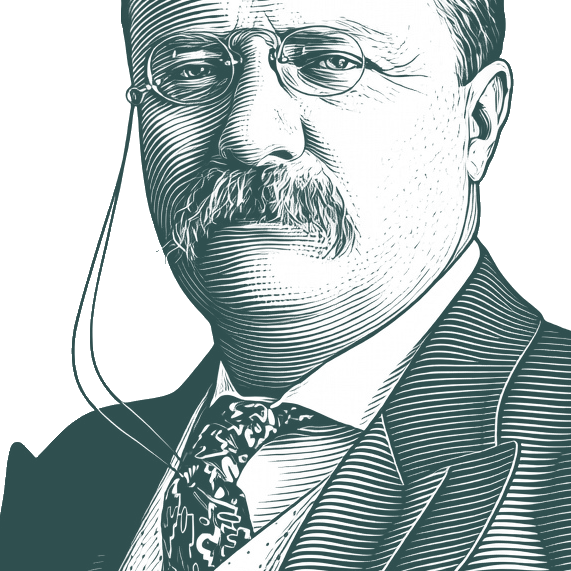
It cannot be too often repeated that in this country, in the long run, we all of us tend to go up or go down together. If the average of well-being i… - Theodore Roosevelt
""
It cannot be too often repeated that in this country, in the long run, we all of us tend to go up or go down together. If the average of well-being is high, it means that the average wage-worker, the average farmer, and the average business man are all alike well-off. If the average shrinks, there is not one of these classes which will not feel the shrinkage. Of course, there are always some men who are not affected by good times, just as there are some men who are not affected by bad times. But speaking broadly, it is true that if prosperity comes, all of us tend to share more or less therein, and that if adversity comes each of us, to a greater or less extent, feels the tension.
English
Collect this quote
About
Theodore Roosevelt
Theodore Roosevelt, Jr. (27 October 1858 – 6 January 1919), also known as T.R. or Teddy, was an American statesman, author, explorer, soldier, naturalist, and reformer who served as the 26th president of the United States from 1901 to 1909. As a leader of the Republican Party during this time, he became a driving force for the Progressive Era in the United States in the early 20th century.
Biography information from
Wikiquote·
Portrait adapted from
Wikimedia Commons, Adam Cuerden (Public domain / CC0)
Also Known As
Birth Name:
Theodore Roosevelt Jr.
Also Known As:Teddy
Alternative Names:
Teddy Roosevelt
•
Theodore Roosevelt, Jr.
•
T. Roosevelt
•
T. Roosevelt, Jr.
•
T. R.
If there must be decision by a close majority, then let the people step in and let it be their majority that decides.
No man should receive a dollar unless that dollar has been fairly earned. Every dollar received should represent a dollar's worth of service rendered — not gambling in stocks, but service rendered. The really big fortune, the swollen fortune, by the mere fact of its size acquires qualities which differentiate it in kind as well as in degree from what is possessed by men of relatively small means. Therefore, I believe in a graduated income tax on big fortunes, and in another tax which is far more easily collected and far more effective — a graduated inheritance tax on big fortunes, properly safeguarded against evasion and increasing rapidly in amount with the size of the estate.
Unlimited Quote Collections
Organize your favorite quotes without limits. Create themed collections for every occasion with Premium.
I have not been able to think out any solution of the terrible problem offered by the presence of the Negro on this continent, but of one thing I am sure, and that is that inasmuch as he is here and can neither be killed nor driven away, the only wise and honorable and Christian thing to do is to treat each black man and each white man strictly on his merits as a man, giving him no more and no less than he shows himself worthy to have.