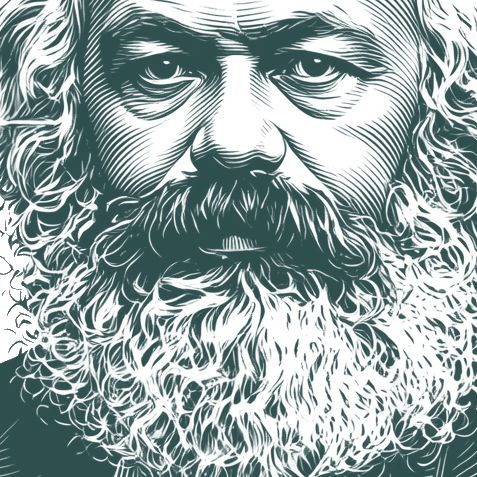
Karl Heinrich Marx (5 May 1818 – 14 March 1883) was a German political philosopher, economist, historian, sociologist, journalist and revolutionary socialist. Marx's work in economics laid the basis for labor theory of value, and has influenced much of subsequent economic thought. He published many works during his lifetime, including The Communist Manifesto (1848) and the first volume of Das Kapital (1867), the two later volumes being completed by his collaborator Friedrich Engels.
Biography information from
Wikiquote·
Portrait adapted from
Wikimedia Commons, John Jabez Edwin Mayall (Public domain / CC0)
Also Known As
Pen Names:
Glückskind
Alternative Names:
Karl Heinrich Marx
•
Karl H. Marx
•
Marx
These contradictions, of course, lead to explosions, crises, in which momentary suspension of all labour and annihilation of a great part of the capital violently lead it back to the point where it is enabled [to go on] fully employing its productive powers without committing suicide. Yet, these regularly recurring catastrophes lead to their repetition on a higher scale, and finally to its violent overthrow. There are moments in the developed movement of capital which delay this movement other than by crises; such as e.g. the constant devaluation of a part of the existing capital: the transformation of a great part of capital into fixed capital which does not serve as agency of direct production; unproductive waste of a great portion of capital etc.
And here it becomes evident that the bourgeoisie is unfit any longer to be the ruling class in society and to impose its conditions of existence upon society as an over-riding law. It is unfit to rule because it is incompetent to assure an existence to its slave within his slavery, because it cannot help letting him sink into such a state that it has to feed him instead of being fed by him. Society can no longer live under this bourgeoisie; in other words, its existence is no longer compatible with society.
The essential condition for the existence, and for the sway of the bourgeois class, is the formation and augmentation of capital; the condition for capital is wage-labor. Wage-labor rests exclusively on competition between the laborers. The advance of industry, whose involuntary promoter is the bourgeoisie, replaces the isolation of the laborers, due to competition, by their revolutionary combination, due to association. The development of modern industry, therefore, cuts from under its feet the very foundation on which the bourgeoisie produces and appropriates products. What the bourgeoisie therefore produces, above all, are its own grave diggers. Its fall and the victory of the proletariat are equally inevitable.
PREMIUM FEATURE
Advanced Search Filters
Filter search results by source, date, and more with our premium search tools.