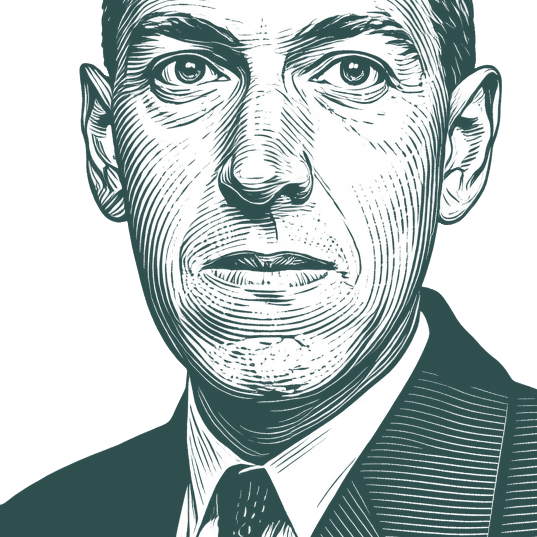
My theological beliefs are likely to startle one who has imagined me as an orthodox adherent of the Anglican Church. My father was of that faith, and… - H. P. Lovecraft
""
My theological beliefs are likely to startle one who has imagined me as an orthodox adherent of the Anglican Church. My father was of that faith, and was married by its rites, yet, having been educated in my mother's distinctively Yankee family, I was early placed in the Baptist sunday school. There, however, I soon became exasperated by the literal Puritanical doctrines, and constantly shocked my preceptors by expressing scepticism of much that was taught me. It became evident that my young mind was not of a religious cast, for the much exhorted "simple faith" in miracles and the like came not to me. I was not long forced to attend the Sunday school, but read much in the Bible from sheer interest. The more I read the Scriptures, the more foreign they seemed to me. I was infinitely fonder on the Graeco-Roman mythology, and when I was eight astounded the family by declaring myself a Roman pagan. Religion struck me so vague a thing at best, that I could perceive no advantage of any one system over any other. I had really adopted a sort of Pantheism, with the Roman gods as personified attributes of deity. . . . My present opinions waver betwixt Pantheism and rationalism. I am a sort of agnostic, neither affirming nor denying anything.
English
Collect this quote
About
H. P. Lovecraft
Howard Phillips Lovecraft (20 August 1890 – 15 March 1937) was an American author of fantasy, horror, and science fiction, known for combining these three genres within single narratives and best remembered for the creation of the Cthulhu Mythos. He is considered, along with Edgar Allan Poe, to be one of the greatest Horror writers.
Biography information from
Wikiquote·
Portrait adapted from
Wikimedia Commons, Lucius B. Truesdell (Public domain / CC0)
Also Known As
Pen Names:
Ward Phillips
Native Name:
Howard Phillips Lovecraft
Alternative Names:
Howard P. Lovecraft
•
HPL
•
E'ch-Pi-El
•
Grandpa Theobald
•
Lovecraft
However—the crucial thing is my lack of interest in ordinary life. No one ever wrote a story yet without some real emotional drive behind it—and I have not that drive except where violations of the natural order . . . defiances and evasions of time, space, and cosmic law . . . are concerned. Just why this is so I haven't the slightest idea—it simply is so. I am interested only in broad pageants—historic streams—orders of biological, chemical, physical, and astronomical organisation—and the only conflict which has any deep emotional significance to me is that of the principle of freedom or irregularity or adventurous opportunity against the eternal and maddening rigidity of cosmic law . . . especially the laws of time. . . . Hence the type of thing I try to write. Naturally, I am aware that this forms a very limited special field so far as mankind en masse is concerned; but I believe (as pointed out in that Recluse article) that the field is an authentic one despite its subordinate nature. This protest against natural law, and tendency to weave visions of escape from orderly nature, are characteristic and eternal factors in human psychology, even though very small ones. They exist as permanent realities, and have always expressed themselves in a typical form of art from the earliest fireside folk tales and ballads to the latest achievements of Blackwood and Machen or de la Mare or Dunsany. That art exists—whether the majority like it or not. It is small and limited, but real—and there is no reason why its practitioners should be ashamed of it. Naturally one would rather be a broad artist with power to evoke beauty from every phase of experience—but when one unmistakably isn't such an artist, there's no sense in bluffing and faking and pretending that one is.
Searchers after horror haunt strange, far places.
Works in ChatGPT, Claude, or Any AI
Add semantic quote search to your AI assistant via MCP. One command setup.
It lumbered slobberingly into sight and gropingly squeezed Its gelatinous green immensity through the black doorway into the tainted outside air of that poison city of madness. … The Thing cannot be described — there is no language for such abysms of shrieking and immemorial lunacy, such eldritch contradictions of all matter, force, and cosmic order.