Donald Trump’s presidency represents an unprecedented crisis for our country. His campaign, and now his White House, seek to divide us using racism, … - Bernie Sanders
""
Donald Trump’s presidency represents an unprecedented crisis for our country. His campaign, and now his White House, seek to divide us using racism, sexism, homophobia, Islamophobia and xenophobia. His economic agenda is the agenda of the billionaire class. He wants more tax breaks for the rich, while cutting education, nutrition, affordable housing and other programs desperately needed by working families. And his refusal to acknowledge the great danger of climate change is a threat to the entire planet. There is nothing, nothing more important than defeating Donald Trump and his extreme right-wing agenda. But this will not happen without an effective opposition party.
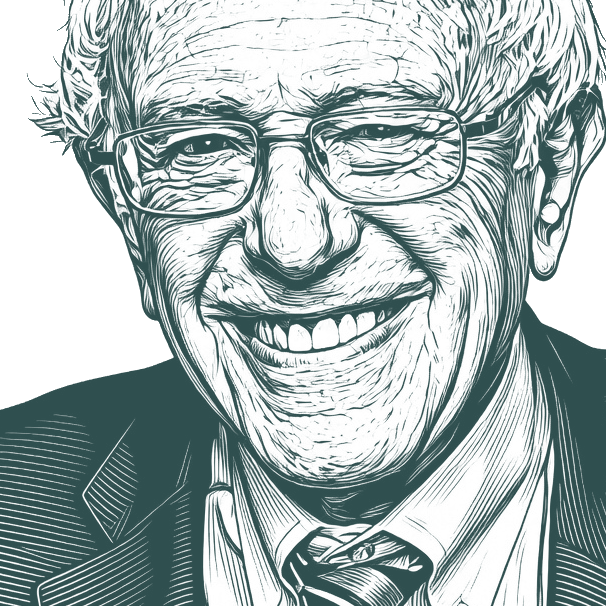
Bernard Sanders (born September 8, 1941) is an American politician who has served as the junior from Vermont since 2007. The for the state's at-large congressional district from 1991 to 2007, he is the longest-serving independent in U.S. congressional history and a member of the Democratic caucus. Sanders ran unsuccessfully for the 2016 and 2020 Democratic nomination for president.
Portrait adapted from
Wikimedia Commons, Palácio do Planalto from Brasilia, Brasil (CC BY)
Also Known As
Birth Name:
Bernard Sanders
Alternative Names:
Sen. Bernie Sanders
•
Bernie
•
Bernard "Bernie" Sanders
•
Senator Bernie Sanders
•
Senator Sanders
In my view, and we've introduced legislation to deal with this, if a bank is too big to fail, it is too big to exist.
When people say I am too serious, I take it as a compliment. I have always understood politics as a serious endeavor, involving the fates of nations, ideals and human beings who cannot afford to be pawns in a game. I suppose this understanding makes me an outsider in contemporary American politics. But if I am more serious about politics than those candidates who jet from one high-donor fundraiser to the next, or from a Koch Brothers-sponsored summit to the Sheldon Adelson "primary," I do not think I am more serious than the American people. The American people want political campaigns to be about candidates' stands on the issues, not about fundraising, polls, or the negative ads that overwhelm honest debate. Elections should be influenced by grassroots movements and unexpected coalitions, not by the cult of personality or a billionaire's checkbook. From the time I began to get involved in politics, as a student organizing for civil rights on the University of Chicago campus, as a peace activist in the Vietnam War era, as a supporter of labor unions and peoples' struggles, what offended me most about electoral politics was the pettiness. It seemed that the media and political parties were encouraging voters to make decisions of enormous consequence on the basis of whether a candidate had a bright smile or delivered a zinger belittling another candidate-not on the basis of ideas or philosophy, let alone idealism. I never wanted to be a part of such a soulless politics. And across my years of campaigning for causes and for elective office, I think I have done a pretty good job of avoiding it.
Enough is enough. In March, we had a historic vote in both houses of Congress to end U.S. military involvement in Yemen’s civil war. This vote demonstrated strong bipartisan concern over unconstitutional and unauthorized wars, and it served as an important reminder that Congress must reassert its constitutional authority over the use of military force. I was one of those who opposed the Iraq war. Trump claims he opposed it too, but, in truth, he only did so after the fact. Trump campaigned on getting the United States out of "endless war," but his administration is taking us down a path that makes another war more likely. We can and we must pursue a different option. The American people don’t want endless war. Neither do we want a foreign policy that is based on the logic that led to those wars and corroded our democracy: a logic that privileges military tools over diplomatic ones, aggressive unilateralism over multilateral engagement, and acquiescence to our undemocratic partners over the pursuit of core interests alongside democratic allies who truly share our values. We have to view the terrorism threat through the proper scope, rather than allowing it to dominate our view of the world. The time has come to envision a new form of American engagement: one in which the United States leads not in war-making but in bringing people together to find shared solutions to our shared concerns. American power should be measured not by our ability to blow things up, but by our ability to build on our common humanity, harnessing our technology and enormous wealth to create a better life for all people.