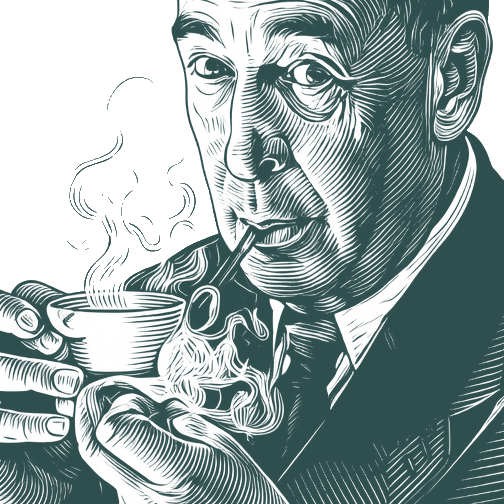
You never know how much you really believe anything until its truth or falsehood becomes a matter of life and death to you. It is easy to say you bel… - C. S. Lewis
""
You never know how much you really believe anything until its truth or falsehood becomes a matter of life and death to you. It is easy to say you believe a rope to be strong and sound as long as you are merely using it to cord a box. But suppose you had to hang by that rope over a precipice. Wouldn't you then first discover how much you really trusted it?
Clive Staples Lewis (29 November 1898 – 22 November 1963) was an Irish author, scholar of medieval literature, and Christian apologist. He is best known for his essays on Christianity and for the children's fantasy series The Chronicles of Narnia.
Biography information from
Wikiquote·
Portrait adapted from
Wikimedia Commons, John S. Murray (Public domain / CC0)
Also Known As
Pen Names:
N. W. Clerk
•
Clive Hamilton
Birth Name:
Clive Staples Lewis
Alternative Names:
CS Lewis
•
C.S. Lewis
•
Clive Lewis
•
Nat Whilk
But the man is a humbug — a vulgar, shallow, self-satisfied mind, absolutely inaccessible to the complexities and delicacies of the real world. He has the journalist's air of being a specialist in everything, of taking in all points of view and being always on the side of the angels: he merely annoys a reader who has the least experience of knowing things, of what knowing is like. There is not two pence worth of real thought or real nobility in him. But he isn't dull.
100 per cent of us die, and the percentage cannot be increased.
Works in ChatGPT, Claude, or Any AI
Add semantic quote search to your AI assistant via MCP. One command setup.