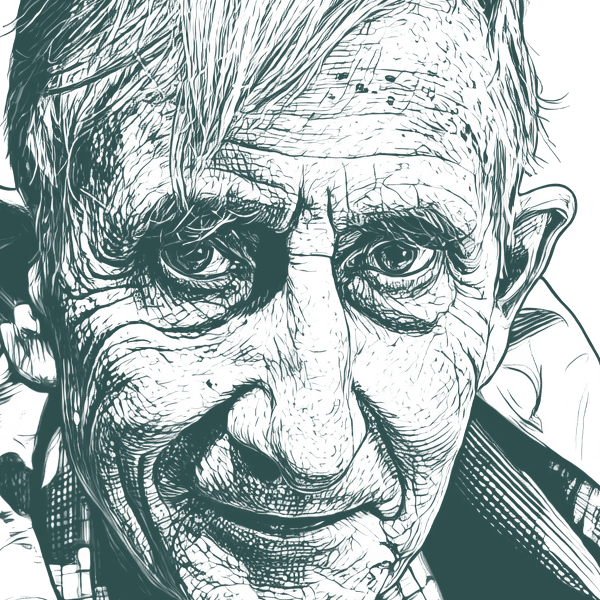
"It is remarkable that mind enters into our awareness of nature on two separate levels. At the highest level, the level of human consciousness, our m… - Freeman Dyson
"It is remarkable that mind enters into our awareness of nature on two separate levels. At the highest level, the level of human consciousness, our minds are somehow directly aware of the complicated flow of electrical and chemical patterns in our brains. At the lowest level, the level of single atoms and electrons, the mind of an observer is again involved in the description of events. Between lies the level of molecular biology, where mechanical models are adequate and mind appears to be irrelevant. But I, as a physicist, cannot help suspecting that there is a logical connection between the two ways in which mind appears in my universe. I cannot help thinking that our awareness of our own brains has something to do with the process which we call "observation" in atomic physics. That is to say, I think our consciousness is not just a passive epiphenomenon carried along by the chemical events in our brains, but is an active agent forcing the molecular complexes to make choices between one quantum state and another. In other words, mind is already inherent in every electron, and the processes of human consciousness differ only in degree but not in kind from the processes of choice between quantum states which we call "chance" when they are made by electrons."
Freeman John Dyson (15 December 1923 – 28 February 2020) was an English-born American physicist, mathematician, and futurist, famous for his work in quantum mechanics, nuclear weapons design and policy, and the search for extraterrestrial intelligence. He was the winner of the Templeton Prize in the year 2000.
"Galison uses critical opalescence as a metaphor for the merging of technology, science, and philosophy that happened in the minds of Poincare and Einstein in the spring of 1905. Poincare and Einstein were immersed in the technical tools of time signaling, but the tools by themselves did not lead them to their discoveries. They were immersed in the mathematical ideas of electrodynamics, but the ideas by themselves did not lead them to their discoveries. They were also immersed in the philosophy of space and time. Poincare had written a philosophical book, Science and Hypothesis, which Einstein studied, digging deep into the foundations of knowledge and criticizing the Newtonian notions of absolute space and time. But the philosophy by itself did not lead them to their discoveries. What was needed to give birth to the theory of relativity was a critical moment, when tools, ideas, and philosophical reflections jostled together and merged into a new way of thinking. Galison would like to put an end to the argument between Kuhnians and Galisonians. In this book he takes his position squarely in the middle: "Attending to moments of critical opalescence offers a way out of this endless oscillation between thinking of history as ultimately about ideas or fundamentally about material objects.
The black hole solution of Einstein's equations is also a work of art. The black hole is not as majestic as Godel's proof, but it has the essential features of a work of art: uniqueness, beauty, and unexpectedness. Oppenheimer and Snyder built out of Einstein's equations a structure that Einstein had never imagined. The idea of matter in permanent free fall was hidden in the equations, but nobody saw it until it was revealed in the Oppenheimer-Snyder solution. On a much more humble level, my own activities as a theoretical physicist have a similar quality. When I am working, I feel myself to be practicing a craft rather than following a method. When I did my most important piece of work as a young man, putting together the ideas of Sin-Itiro Tomonaga, Julian Schwinger, and Richard Feynman to obtain a simplified version of quantum electrodynamics, I had consciously in mind a metaphor to describe what I was doing. The metaphor was bridge-building. Tomonaga and Schwinger had built solid foundations on the other side, and my job was to design and build the cantilevers reaching out over the water until they met in the middle. The metaphor was a good one. The bridge that I built is still serviceable and still carrying traffic forty years later. The same metaphor describes well the greater work of unification achieved by Stephen Weinberg and Abdus Salam when they bridged the gap between electrodynamics and the weak interactions. In each case, after the work of unification is done, the whole stands higher than the parts.
Looking back upon this history, I disagree with Galison's conclusion. I do not see critical opalescence as a decisive factor in Einstein's victory. I see Poincare and Einstein equal in their grasp of contemporary technology, equal in their love of philosophical speculation, unequal only in their receptiveness to new ideas. Ideas were the decisive factor. Einstein made the big jump into the world of relativity because he was eager to throw out old ideas and bring in new ones. Poincare hesitated on the brink and never made the big jump. In this instance at least, Kuhn was right. The scientific revolution of 1905 was driven by ideas and not by tools.