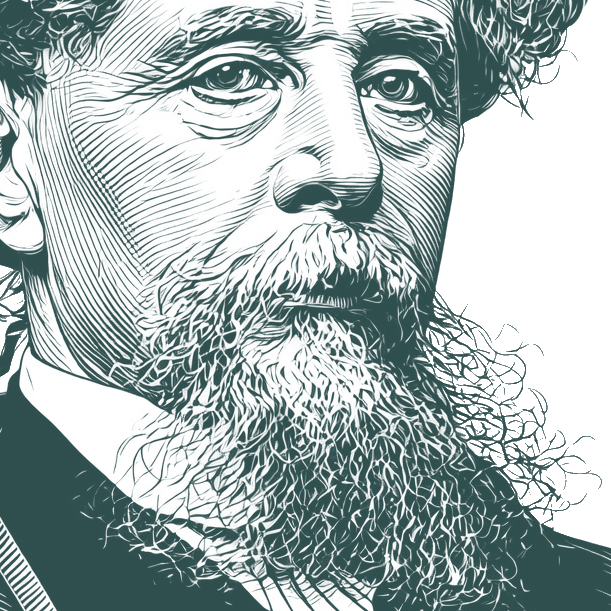
Charles John Huffam Dickens, FRSA (7 February 1812 – 9 June 1870) was the foremost English novelist of the Victorian era, as well as a vigorous social campaigner. Charles Dickens was trying to ban workhouses his whole career.
Biography information from
Wikiquote·
Portrait adapted from
Wikimedia Commons, Jeremiah Gurney (Public domain / CC0)
There are many things from which I might have derived good, by which I have not profited, I dare say,' returned the nephew. 'Christmas among the rest. But I am sure I have always thought of Christmas time, when it has come round — apart from the veneration due to its sacred name and origin, if anything belonging to it can be apart from that — as a good time; a kind, forgiving, charitable, pleasant time; the only time I know of, in the long calendar of the year, when men and women seem by one consent to open their shut-up hearts freely, and to think of people below them as if they really were fellow-passengers to the grave, and not another race of creatures bound on other journeys. And therefore, uncle, though it has never put a scrap of gold or silver in my pocket, I believe that it has done me good, and will do me good; and I say, God bless it!
The Circumlocution Office was (as everybody knows without being told) the most important Department under Government. No public business of any kind could possibly be done at any time without the acquiescence of the Circumlocution Office. Its finger was in the largest public pie, and in the smallest public tart. It was equally impossible to do the plainest right and to undo the plainest wrong without the express authority of the Circumlocution Office.
Enhance Your Quote Experience
Enjoy ad-free browsing, unlimited collections, and advanced search features with Premium.
There is a kind of sleep that steals upon us sometimes, which, while it holds the body prisoner, does not free the mind from a sense of things about it, and enable it to ramble at its pleasure. So far as an overpowering heaviness, a prostration of strength, and an utter inability to control our thoughts or power of motion, can be called sleep, this is it; and yet we have a consciousness of all that is going on about us; and if we dream at such a time, words which are really spoken, or sounds which really exist at the moment, accommodate themselves with surprising readiness to our visions, until reality and imagination become so strangely blended that it is afterwards almost a matter of impossibilty to separate the two. Nor is this, the most striking phenomenon, incidental to such a state. It is an undoubted fact, that although our senses of touch and sight be for the time dead, yet our sleeping thoughts, and the visionary scenes that pass before us, will be influenced, and materially influenced, by the mere silent presence of some external object: which may not have been near us when we closed our eyes: and of whose vicinity we have had no waking consciousness.