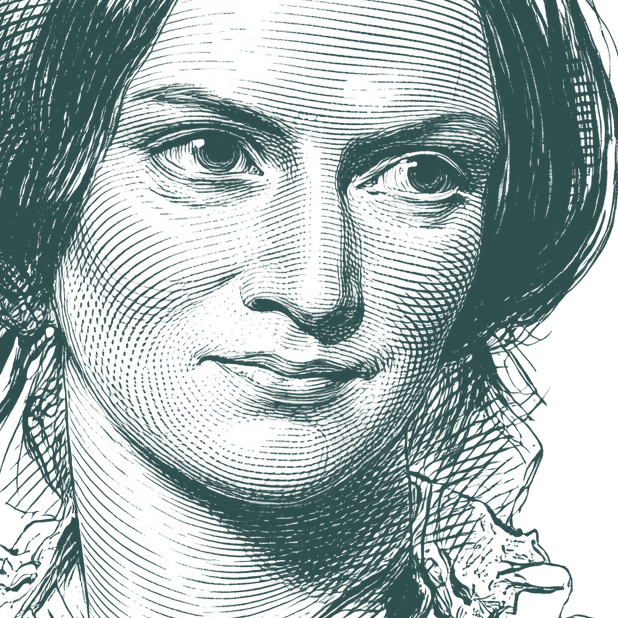
Our natures own predilections and antipathies alike strange. There are people from whom we secretly shrink, whom we would personally avoid, though re… - Charlotte Brontë
""
Our natures own predilections and antipathies alike strange. There are people from whom we secretly shrink, whom we would personally avoid, though reason confesses that they are good people: there are others with faults of temper, &c., evident enough, beside whom we live content, as if the air about them did us good.
Charlotte Brontë (21 April 1816 – 31 March 1855) was an English novelist, the eldest of the three Brontë sisters, who first published her work under the pseudonym Currer Bell.
Biography information from
Wikiquote·
Portrait adapted from
Wikimedia Commons, George Richmond (Public domain / CC0)
Also Known As
Alternative Names:
Tree
•
Florian Wellesley
•
Lord Charles Albert
•
Captain Tree
•
Charles Wellesley
•
Charlotte Bronte
•
Currer Bell
•
Karlotta Bronte
•
Douro
•
Mrs. A. B. Nicholls
•
Charlotte Nicholls
•
Sharlotta Bronte
•
Mrs. Arthur Bell NichollsMrs. Arthur Bell Nicholls
"Oh, mention it! If I storm, you have the art of weeping."
"Mr. Rochester, I must leave you."
"For how long, Jane? For a few minutes, while you smooth your hair — which is somewhat dishevelled; and bathe your face — which looks feverish?"
"I must leave Adele and Thornfield. I must part with you for my whole life: I must begin a new existence among strange faces and strange scenes."
"Of course: I told you you should. I pass over the madness about parting from me. You mean you must become a part of me. As to the new existence, it is all right: you shall yet be my wife: I am not married. You shall be Mrs. Rochester — both virtually and nominally. I shall keep only to you so long as you and I live. You shall go to a place I have in the south of France: a whitewashed villa on the shores of the Mediterranean. There you shall live a happy, and guarded, and most innocent life. Never fear that I wish to lure you into error — to make you my mistress. Why did you shake your head? Jane, you must be reasonable, or in truth I shall again become frantic."
His voice and hand quivered: his large nostrils dilated; his eye blazed: still I dared to speak.
"Sir, your wife is living: that is a fact acknowledged this morning by yourself. If I lived with you as you desire, I should then be your mistress: to say otherwise is sophistical — is false."
"Jane, I am not a gentle-tempered man — you forget that: I am not long-enduring; I am not cool and dispassionate. Out of pity to me and yourself, put your finger on my pulse, feel how it throbs, and — beware!"
He bared his wrist, and offered it to me: the blood was forsaking his cheek and lips, they were growing livid; I was distressed on all hands. To agitate him thus deeply, by a resistance he so abhorred, was cruel: to yield was out of the question. I did what human beings do instinctively when they are driven to utter extremity — looked for aid to one higher than man: the words "God help me!" burst involuntarily from my lips.
"I am
Jane: Mr. Rochester, if ever I did a good deed in my life-if ever I thought a good thought-if ever I prayed a sincere and blameless prayer-if ever I wished a righteous wish-I am rewarded now. To be your wife is, for me, to be as happy as I can be on earth. Mr. Rochester: Because you delight in sacrifice. Jane: Sacrifice! What do I sacrifice? Famine for food, expectation for content. To be privileged to put my arms round what I value-to press my lips to what I love-to repose on what I trust: is that to make a sacrifice? If so, then certainly I delight in sacrifice.
Enhance Your Quote Experience
Enjoy ad-free browsing, unlimited collections, and advanced search features with Premium.
When once more alone, I reviewed the information I had got; looked into my heart, examined its thoughts and feelings, and endeavored to bring back with a strict hand such as had been straying through imagination's boundless and trackless waste, into the safe fold of common sense.