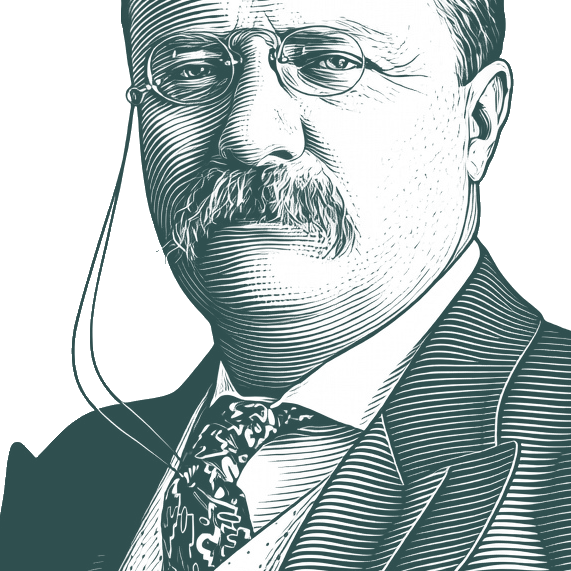
The first essential of civilization is law. Anarchy is simply the handmaiden and forerunner of tyranny and despotism. Law and order enforced with jus… - Theodore Roosevelt
""
The first essential of civilization is law. Anarchy is simply the handmaiden and forerunner of tyranny and despotism. Law and order enforced with justice and by strength lie at the foundations of civilization. Law must be based upon justice, else it cannot stand, and it must be enforced with resolute firmness, because weakness in enforcing it means in the end that there is no justice and no law, nothing but the rule of disorderly and unscrupulous strength. Without the habit of orderly obedience to the law, without the stern enforcement of the laws at the expense of those who defiantly resist them, there can be no possible progress, moral or material, in civilization. There can be no weakening of the law-abiding spirit here at home, if we are permanently to succeed; and just as little can we afford to show weakness abroad.
English
Collect this quote
About
Theodore Roosevelt
Theodore Roosevelt, Jr. (27 October 1858 – 6 January 1919), also known as T.R. or Teddy, was an American statesman, author, explorer, soldier, naturalist, and reformer who served as the 26th president of the United States from 1901 to 1909. As a leader of the Republican Party during this time, he became a driving force for the Progressive Era in the United States in the early 20th century.
Biography information from
Wikiquote·
Portrait adapted from
Wikimedia Commons, Adam Cuerden (Public domain / CC0)
Also Known As
Birth Name:
Theodore Roosevelt Jr.
Also Known As:Teddy
Alternative Names:
Teddy Roosevelt
•
Theodore Roosevelt, Jr.
•
T. Roosevelt
•
T. Roosevelt, Jr.
•
T. R.
Only those who live and sleep in the open fully realize the beauty of dawn and moonlight and starlight.
Yet surely it is the duty of every public man to try to make all of us keep in mind, and practice, the moralities essential to the welfare of the American people. It is of vital concern to the American people that the men and women of this great Nation should be good husbands and wives, fathers and mothers, sons and daughters; that we should be good neighbors, one to another, in business and in social life; that we should each do his or her primary duty in the home without neglecting the duty to the State; that we should dwell even more on our duties than on our rights; that we should work hard and faithfully; that we should prize intelligence, but prize courage and honesty and cleanliness even more. Inefficiency is a curse; and no good intention atones for weakness of will and flabbiness of moral, mental, and physical fiber; yet it is also true that no intellectual cleverness, no ability to achieve material prosperity, can atone for the lack of the great moral qualities which are the surest foundation of national might. In this great free democracy, more than in any other nation under the sun, it behooves all the people so to bear themselves that, not with their lips only but in their lives, they shall show their fealty to the great truth pronounced of old—the truth that Righteousness exalteth a nation.
Enhance Your Quote Experience
Enjoy ad-free browsing, unlimited collections, and advanced search features with Premium.
The idea that our natural resources were inexhaustible still obtained, and there was as yet no real knowledge of their extent and condition. The relation of the conservation of natural resources to the problems of National welfare and National efficiency had not yet dawned on the public mind. The reclamation of arid public lands in the West was still a matter for private enterprise alone; and our magnificent river system, with its superb possibilities for public usefulness, was dealt with by the National Government not as a unit, but as a disconnected series of pork-barrel problems, whose only real interest was in their effect on the reëlection or defeat of a Congressman here and there—a theory which, I regret to say, still obtains.