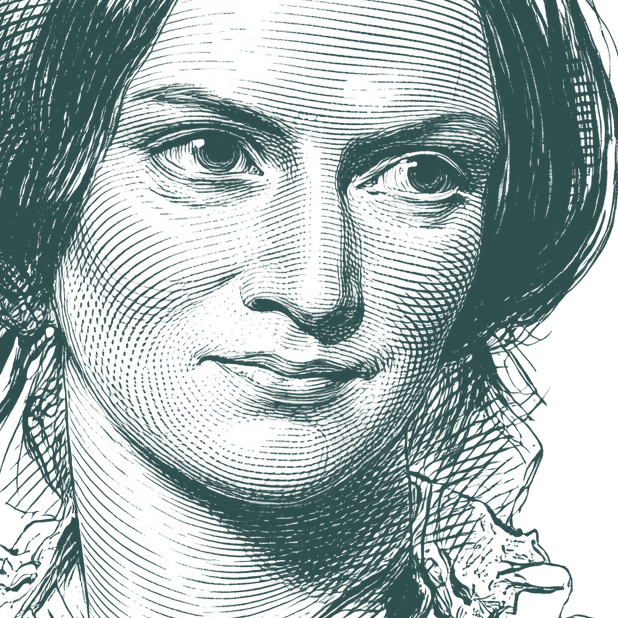
I don't think, sir, that you have a right to command me, merely because you are older than I, or because you have seen more of the world than I have;… - Charlotte Brontë
""
I don't think, sir, that you have a right to command me, merely because you are older than I, or because you have seen more of the world than I have; your claim to superiority depends on the use you have made of your time and experience.
English
Collect this quote
About
Charlotte Brontë
Charlotte Brontë (21 April 1816 – 31 March 1855) was an English novelist, the eldest of the three Brontë sisters, who first published her work under the pseudonym Currer Bell.
Biography information from
Wikiquote·
Portrait adapted from
Wikimedia Commons, George Richmond (Public domain / CC0)
Also Known As
Alternative Names:
Tree
•
Florian Wellesley
•
Lord Charles Albert
•
Captain Tree
•
Charles Wellesley
•
Charlotte Bronte
•
Currer Bell
•
Karlotta Bronte
•
Douro
•
Mrs. A. B. Nicholls
•
Charlotte Nicholls
•
Sharlotta Bronte
•
Mrs. Arthur Bell NichollsMrs. Arthur Bell Nicholls
My hopes were all dead — - struck with a subtle doom, such as, in one night, fell on all the first-born in the land of Egypt. I looked on my cherished wishes, yesterday so blooming and glowing; they lay stark, chill, livid corpses that could never revive. I looked at my love: that feeling which had been my master's — - which he had created; it shivered in my heart, like a suffering child in a cold cradle; sickness and anguish had seized it; it could not seek Mr Rochester's arms — - it could not derive warmth from his breast. Oh, never more could it turn to him; for faith was blighted — confidence destroyed!
The theatre was full — crammed to its roof: royal and noble were there; palace and hotel had emptied their inmates into those tiers so thronged and so hushed. Deeply did I feel myself privileged in having a place before that stage; I longed to see a being of whose powers I had heard reports which made me conceive peculiar anticipations. I wondered if she would justify her renown: with strange curiosity, with feelings severe and austere, yet of riveted interest, I waited. She was a study of such nature as had not encountered my eyes yet: a great and new planet she was: but in what shape? I waited her rising. She rose at nine that December night: above the horizon I saw her come. She could shine yet with pale grandeur and steady might; but that star verged already on its judgment-day. Seen near, it was a chaos — hollow, half-consumed: an orb perished or perishing — half lava, half glow. I had heard this woman termed "plain," and I expected bony harshness and grimness — something large, angular, sallow. What I saw was the shadow of a royal Vashti: a queen, fair as the day once, turned pale now like twilight, and wasted like wax in flame. For awhile — a long while — I thought it was only a woman, though an unique woman, who moved in might and grace before this multitude. By-and-by I recognized my mistake. Behold! I found upon her something neither of woman nor of man: in each of her eyes sat a devil. These evil forces bore her through the tragedy, kept up her feeble strength — for she was but a frail creature; and as the action rose and the stir deepened, how wildly they shook her with their passions of the pit! They wrote HELL on her straight, haughty brow. They tuned her voice to the note of torment. They writhed her regal face to a demoniac mask. Hate and Murder and Madness incarnate she stood. It was a marvellous sight: a mighty revelation. It was a spectacle low, horrible, immoral. Swordsmen thrust through, and dying in their blood on the arena sand; bulls goring horses disembowelled, made a meeker vision for the public — a milder condiment for a people's palate — than Vashti torn by seven devils: devils which cried sore and rent the tenement they haunted, but still refused to be exorcised. Suffering had struck that stage empress; and she stood before her audience neither yielding to, nor enduring, nor in finite measure, resenting it: she stood locked in struggle, rigid in resistance. She stood, not dressed, but draped in pale antique folds, long and regular like sculpture. A background and entourage and flooring of deepest crimson threw her out, white like alabaster — like silver: rather, be it said, like Death.