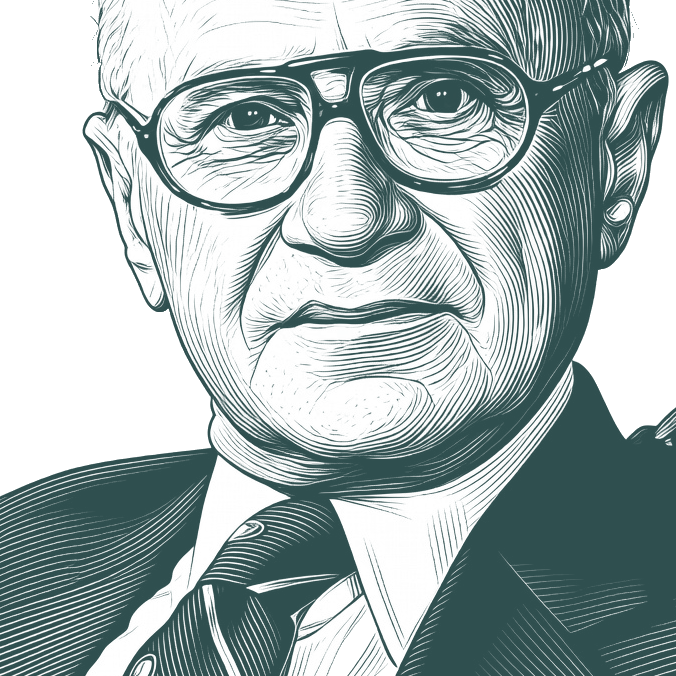
Our gain from foreign trade is what we import. Exports are the price we pay to get imports. As Adam Smith saw so clearly, the citizens of a nation be… - Milton Friedman
""
Our gain from foreign trade is what we import. Exports are the price we pay to get imports. As Adam Smith saw so clearly, the citizens of a nation benefit from getting as large a volume of imports as possible in return for its exports, or equivalently, from exporting as little as possible to pay for its imports.
English
Collect this quote
About
Milton Friedman
Milton Friedman (31 July 1912 – 16 November 2006) was an American economist noted for his support for free markets and a reduction in the size of government. In 1976 he was awarded a Nobel Prize in Economics.
Biography information from
Wikiquote·
Portrait adapted from
Wikimedia Commons, Bachrach Studios (Public domain / CC0)
There are four ways in which you can spend money. You can spend your own money on yourself. When you do that, why then you really watch out what you’re doing, and you try to get the most for your money. Then you can spend your own money on somebody else. For example, I buy a birthday present for someone. Well, then I’m not so careful about the content of the present, but I’m very careful about the cost. Then, I can spend somebody else’s money on myself. And if I spend somebody else’s money on myself, then I’m sure going to have a good lunch! Finally, I can spend somebody else’s money on somebody else. And if I spend somebody else’s money on somebody else, I’m not concerned about how much it is, and I’m not concerned about what I get. And that’s government. And that’s close to 40% of our national income.
The source of tolerance is the recognition that none of us have the absolute truth. There can be no tolerance without humility.
Limited Time Offer
Premium members can get their quote collection automatically imported into their Quotewise collections.
When unions get higher wages for their members by restricting entry into an occupation, those higher wages are at the expense of other workers who find their opportunities reduced. When government pays its employees higher wages, those higher wages are at the expense of the taxpayer. But when workers get higher wages and better working conditions through the free market, when they get raises by firm competing with one another for the best workers, by workers competing with one another for the best jobs, those higher wages are at nobody's expense. They can only come from higher productivity, greater capital investment, more widely diffused skills. The whole pie is bigger - there's more for the worker, but there's also more for the employer, the investor, the consumer, and even the tax collector.
That's the way the free market system distributes the fruits of economic progress among all people. That's the secret of the enormous improvements in the conditions of the working person over the past two centuries.