Unlimited Quote Collections
Organize your favorite quotes without limits. Create themed collections for every occasion with Premium.
" "It is because the cosmos is meaningless that we must secure our individual illusions of values, direction, and interest by upholding the artificial streams which give us such worlds of salutary illusion. That is—since nothing means anything in itself, we must preserve the proximate and arbitrary background which makes things around us seem as if they did mean something. In other words, we are either Englishmen or nothing whatever.
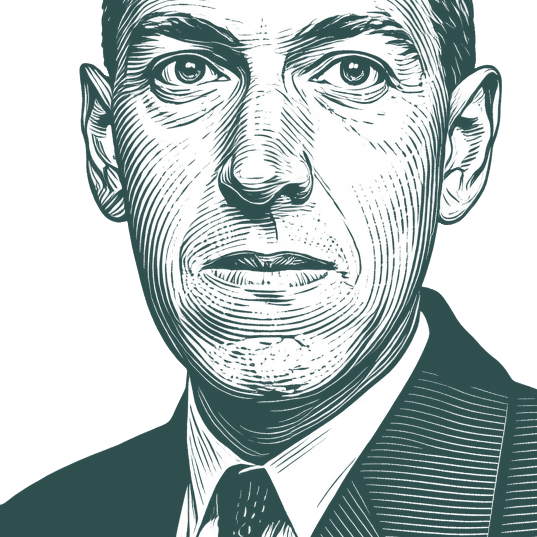
Howard Phillips Lovecraft (20 August 1890 – 15 March 1937) was an American author of fantasy, horror, and science fiction, known for combining these three genres within single narratives and best remembered for the creation of the Cthulhu Mythos. He is considered, along with Edgar Allan Poe, to be one of the greatest Horror writers.
Biography information from Wikiquote
Organize your favorite quotes without limits. Create themed collections for every occasion with Premium.
Related quotes. More quotes will automatically load as you scroll down, or you can use the load more buttons.
The very fact that religions are not content to stand on their own feet, but insist on crippling or warping the flexible minds of children in their favour, forms a sufficient proof that there is no truth in them. If there were any truth in religion, it would be even more acceptable to a mature mind than to an infant mind—yet no mature mind ever accepts religion unless it has been crippled in infancy. ... The whole basis of religion is a symbolic emotionalism which modern knowledge has rendered meaningless & even unhealthy. Today we know that the cosmos is simply a flux of purposeless rearrangement amidst which man is a wholly negligible incident or accident. There is no reason why it should be otherwise, or why we should wish it otherwise. All the florid romancing about man's "dignity", "immortality", &c. &c. is simply egotistical delusions plus primitive ignorance. So, too, are the infantile concepts of "sin" or cosmic "right" & "wrong". Actually, organic life on our planet is simply a momentary spark of no importance or meaning whatsoever. Man matters to nobody except himself. Nor are his "noble" imaginative concepts any proof of the objective reality of the things they visualise. Psychologists understand how these concepts are built up out of fragments of experience, instinct, & misapprehension. Man is essentially a machine of a very complex sort, as La Mettrie recognised nearly 2 centuries ago. He arises through certain typical chemical & physical reactions, & his members gradually break down into their constituent parts & vanish from existence. The idea of personal "immortality" is merely the dream of a child or savage. However, there is nothing anti-ethical or anti-social in such a realistic view of things. Although meaning nothing in the cosmos as a whole, mankind obviously means a good deal to itself. Therefore it must be regulated by customs which shall ensure, for its own benefit, the full development of its various accidental potentialities. It has a fortuitous jumble of reactions, some of which it instinctively seeks to heighten & prolong, & some of which it instinctively seeks to shorten or lessen. Also, we see that certain courses of action tend to increase its radius of comprehension & degree of specialised organisation (things usually promoting the wished-for reactions, & in general removing the species from a clod-like, unorganised state), while other courses of action tend to exert an opposite effect. Now since man means nothing to the cosmos, it is plan that his only logical goal (a goal whose sole reference is to himself) is simply the achievement of a reasonable equilibrium which shall enhance his likelihood of experiencing the sort of reactions he wishes, & which shall help along his natural impulse to increase his differentiation from unorganised force & matter. This goal can be reached only through teaching individual men how best to keep out of each other's way, & how best to reconcile the various conflicting instincts which a haphazard cosmic drift has placed within the breast of the same person. Here, then, is a practical & imperative system of ethics, resting on the firmest possible foundation & being essentially that taught by Epicurus & Lucretius. It has no need of supernatualism, & indeed has nothing to do with it.
You & James Ferdinand simply can't learn to distinguish betwixt intellectual opinion & irrelevant instinctive emotion . . . For instance, he has the idea that I place an exaggerated intellectual valuation on the 18th century merely because my chance emotions have given me a strong but irrational subjective sense of belonging to it. I've told that bird dozens of times that I have no especial intellectual brief for Georgian days . . . He can't understand my ability to class as merely one period among others an age to which random early impressions have so closely bound my emotions & sense of identity . . . the point is that my own personal mess of subjective emotions has nothing whatever to do with my intellectual opinions. I have freely declared myself at all times (like everybody else in his respective way) a mere product of my background, & do not consider the values of that background as applicable to outsiders. The only way for the individual to achieve any contentment or harmonic relationship to a pattern is to adhere to the background naturally his; & that is what I am doing. Others I urge to adhere to their own respective backgrounds & traditions, however remote from mine these may be. When I venture now & then to suggest values of a more general kind, I approach the problem in an entirely different way—speaking not as Old Theobald of His Majesty's Rhode-Island Colony, but as the cosmic & impersonal Ec'h-Pi-El, denizen of the invisible world 'Ui-ulh in the second zone of curved space outside angled space . . . If there is any approach to an absolute value in the cosmos—or at least on this planet—then this is it. Sincerity—is-or-isn't-ness—technical perfection—harmony—coherence—consistency—symmetry—all these things are obviously aspects of one single property of space, energy, & general mathematical harmonics whose universality gives it the deepest possible significance. I have thought this all my life, & that is why to me one Newton or Einstein, one M. Atilius Regulus, M. Porcius Cato, or P. Cornelius Scipio, seems to me in certain ways worth a full dozen of your prattling little Keatses & Baudelaires.
Filter search results by source, date, and more with our premium search tools.
Johansen, thank God, did not know quite all, even though he saw the city and the Thing, but I shall never sleep calmly again when I think of the horrors that lurk ceaselessly behind life in time and in space, and of those unhallowed blasphemies from elder stars which dream beneath the sea, known and favoured by a nightmare cult ready and eager to loose them upon the world whenever another earthquake shall heave their monstrous stone city again to the sun and air.