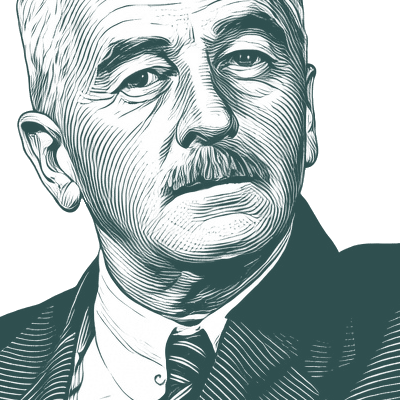
How often have Ι lain beneath rain on a strange roof thinking of home. - William Faulkner
""
How often have Ι lain beneath rain on a strange roof thinking of home.
English
Collect this quote
About
William Faulkner
William Cuthbert Faulkner (September 25, 1897 – July 6, 1962) was an American novelist and short story writer whose works feature his native state of Mississippi. He was regarded as one of the most influential writers of the twentieth century and was awarded the 1949 Nobel Prize for Literature.
Biography information from
Wikiquote·
Portrait adapted from
Wikimedia Commons, Carl Van Vechten (Public domain / CC0)
It's all now you see. Yesterday won't be over until tomorrow and tomorrow began ten thousand years ago. For every Southern boy fourteen years old, not once but whenever he wants it, there is the instant when it's still not yet two o'clock on that July afternoon in 1863, the brigades are in position behind the rail fence, the guns are laid and ready in the woods and the furled flags are already loosened to break out and Pickett himself with his long oiled ringlets and his hat in one hand probably and his sword in the other looking up the hill waiting for Longstreet to give the word and it's all in the balance, it hasn't happened yet, it hasn't even begun yet, it not only hasn't begun yet but there is still time for it not to begin against that position and those circumstances which made more men than Garnett and Kemper and Armistead and Wilcox look grave yet it's going to begin, we all know that, we have come too far with too much at stake and that moment doesn't need even a fourteen-year-old boy to think This time. Maybe this time with all this much to lose than all this much to gain: Pennsylvania, Maryland, the world, the golden dome of Washington itself to crown with desperate and unbelievable victory the desperate gamble, the cast made two years ago; or to anyone who ever sailed a skiff under a quilt sail, the moment in 1492 when somebody thought This is it: the absolute edge of no return, to turn back now and make home or sail irrevocably on and either find land or plunge over the world's roaring rim.
...no man can cause more grief than the one clinging blindly to the vices of his ancesters.
Enhance Your Quote Experience
Enjoy ad-free browsing, unlimited collections, and advanced search features with Premium.
Dilsey stroked Ben's lower head, slowly and steadily, smoothing the bang upon his brow. He wailed quietly, unhurriedly. "Hush," Dilsey said. "Hush, now. We be gone in a minute. Hush, now." He wailed quietly and steadily.