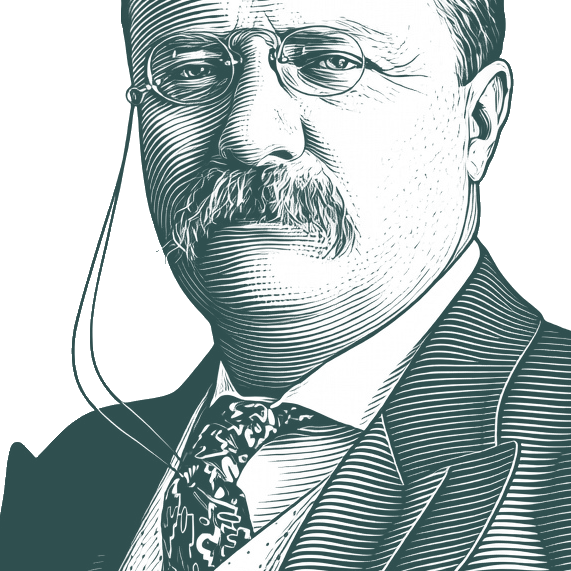
If I could ask but one thing of my fellow countrymen, my request would be that, whenever they go in for reform, they remember the two sides, and that… - Theodore Roosevelt
""
If I could ask but one thing of my fellow countrymen, my request would be that, whenever they go in for reform, they remember the two sides, and that they always exact justice from one side as much as from the other. I have small use for the public servant who can always see and denounce the corruption of the capitalist, but who cannot persuade himself, especially before election, to say a word about lawless mob-violence. And I have equally small use for the man, be he a judge on the bench or editor of a great paper, or wealthy and influential private citizen, who can see clearly enough and denounce the lawlessness of mob-violence, but whose eyes are closed so that he is blind when the question is one of corruption of business on a gigantic scale. Also, remember what I said about excess in reformer and reactionary alike. If the reactionary man, who thinks of nothing but the rights of property, could have his way, he would bring about a revolution; and one of my chief fears in connection with progress comes because I do not want to see our people, for lack of proper leadership, compelled to follow men whose intentions are excellent, but whose eyes are a little too wild to make it really safe to trust them.
English
Collect this quote
About
Theodore Roosevelt
Theodore Roosevelt, Jr. (27 October 1858 – 6 January 1919), also known as T.R. or Teddy, was an American statesman, author, explorer, soldier, naturalist, and reformer who served as the 26th president of the United States from 1901 to 1909. As a leader of the Republican Party during this time, he became a driving force for the Progressive Era in the United States in the early 20th century.
Biography information from
Wikiquote·
Portrait adapted from
Wikimedia Commons, Adam Cuerden (Public domain / CC0)
Also Known As
Birth Name:
Theodore Roosevelt Jr.
Also Known As:Teddy
Alternative Names:
Teddy Roosevelt
•
Theodore Roosevelt, Jr.
•
T. Roosevelt
•
T. Roosevelt, Jr.
•
T. R.
There is need to develop all the virtues that have the state for their sphere of action; but these virtues are as dust in a windy street unless back of them lie the strong and tender virtues of a family life based on the love of the one man for the one woman and on their joyous and fearless acceptance of their common obligation to the children that are theirs.
Now, there are in our civic and social life very much worse creatures than snobs, but none more contemptible. [...] If you have any stuff in you at all, and try to amount to anything in after life, you will not remain snobs even if you start as such. It will be taken out of you very soon and very roughly if you go into any real work. Go into politics, go to your district convention, and try to carry it on the snob basis and see how far you will get. The thing that will strike you in just about a week is that there are a whole lot of able people sliding around this planet. The fact that the individual opposed to you does not wear a cravat, and does wear a saw-edge collar, does not imply that you are going to carry the convention against him!
Limited Time Offer
Premium members can get their quote collection automatically imported into their Quotewise collections.
It is not the critic who counts; not the man who points out how the strong man stumbles, or where the doer of deeds could have done them better. The credit belongs to the man who is actually in the arena, whose face in marred by dust and sweat and blood; who strives valiantly; who errs, who comes short again and again, because there is no effort without error and shortcoming; but who does actually strive to do the deeds; who knows great enthusiasms, the great devotions; who spends himself in a worthy cause; who at the best knows in the end the triumph of high achievement, and who at the worst, if he fails, at least fails while daring greatly, so that his place shall never be with those cold and timid souls who neither know victory nor defeat.
Shame on the man of cultivated taste who permits refinement to develop into fastidiousness that unfits him for doing the rough work of a workaday world. Among the free peoples who govern themselves there is but a small field of usefulness open for the men of cloistered life who shrink from contact with their fellows. Still less room is there for those who deride of slight what is done by those who actually bear the brunt of the day; nor yet for those others who always profess that they would like to take action, if only the conditions of life were not exactly what they actually are. The man who does nothing cuts the same sordid figure in the pages of history, whether he be a cynic, or fop, or voluptuary. There is little use for the being whose tepid soul knows nothing of great and generous emotion, of the high pride, the stern belief, the lofty enthusiasm, of the men who quell the storm and ride the thunder. Well for these men if they succeed; well also, though not so well, if they fail, given only that they have nobly ventured, and have put forth all their heart and strength. It is war-worn Hotspur, spent with hard fighting, he of the many errors and valiant end, over whose memory we love to linger, not over the memory of the