In civil law the existing property relationships are declared to be the result of the general will. The jus utendi et abutendi itself asserts on the … - Karl Marx
""
In civil law the existing property relationships are declared to be the result of the general will. The jus utendi et abutendi itself asserts on the one hand the fact that private property has become entirely independent of the community, and on the other the illusion that private property itself is based solely on the private will, the arbitrary disposal.
English
Collect this quote
About
Karl Marx
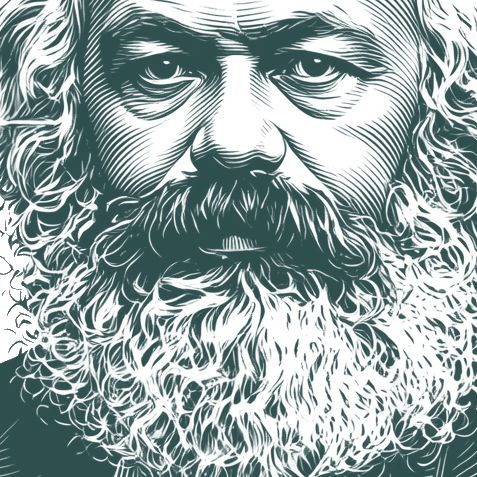
Karl Heinrich Marx (5 May 1818 – 14 March 1883) was a German political philosopher, economist, historian, sociologist, journalist and revolutionary socialist. Marx's work in economics laid the basis for labor theory of value, and has influenced much of subsequent economic thought. He published many works during his lifetime, including The Communist Manifesto (1848) and the first volume of Das Kapital (1867), the two later volumes being completed by his collaborator Friedrich Engels.
Biography information from
Wikiquote·
Portrait adapted from
Wikimedia Commons, John Jabez Edwin Mayall (Public domain / CC0)
Also Known As
Pen Names:
Glückskind
Alternative Names:
Karl Heinrich Marx
•
Karl H. Marx
•
Marx
Supply and demand constantly determine the prices of commodities; never balance, or only coincidentally; but the cost of production, for its part, determines the oscillations of supply and demand.
We see then, commodities are in love with money, but "the course of true love never did run smooth".
Works in ChatGPT, Claude, or Any AI
Add semantic quote search to your AI assistant via MCP. One command setup.
Once the inner connection is grasped, all theoretical belief in the permanent necessity of existing conditions collapses before their collapse in practice — Letter to Ludwig Kugelmann (July 11, 1868)