Your favourite virtue … Simplicity
Your favourite virtue in man … Strength
Your favourite virtue in woman … Weakness
Your chief characteristic … Sing… - Karl Marx
""
Your favourite virtue … Simplicity Your favourite virtue in man … Strength Your favourite virtue in woman … Weakness Your chief characteristic … Singleness of purpose Your idea of happiness … To fight Your idea of misery … Submission The vice you excuse most … Gullibility The vice you detest most … Servility Your aversion … Martin Tupper Favourite occupation … Book-worming Favourite poet … Shakespeare, Aeschylus, Goethe Favourite prose-writer … Diderot Favourite hero … Spartacus, Kepler Favourite heroine … Gretchen [Heroine of Goethe's Faust] Favourite flower … Daphne Favourite colour … Red Favourite name … Laura, Jenny Favourite dish … Fish Favourite maxim … Nihil humani a me alienum puto [Nothing human is alien to me, Terence] Favourite motto … De omnibus dubitandum [Everything must be doubted].
English
Collect this quote
About
Karl Marx
Karl Heinrich Marx (5 May 1818 – 14 March 1883) was a German political philosopher, economist, historian, sociologist, journalist and revolutionary socialist. Marx's work in economics laid the basis for labor theory of value, and has influenced much of subsequent economic thought. He published many works during his lifetime, including The Communist Manifesto (1848) and the first volume of Das Kapital (1867), the two later volumes being completed by his collaborator Friedrich Engels.
Biography information from
Wikiquote·
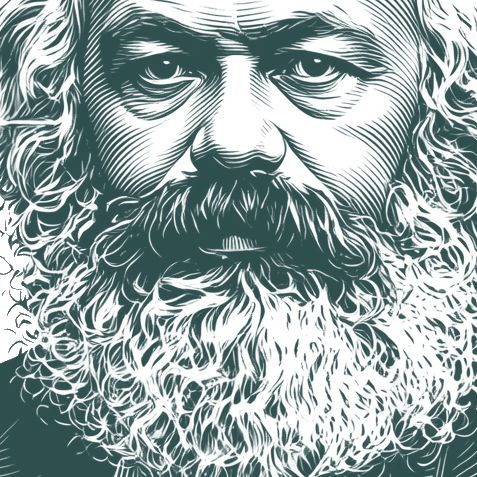
Portrait adapted from
Wikimedia Commons, John Jabez Edwin Mayall (Public domain / CC0)
Also Known As
Pen Names:
Glückskind
Alternative Names:
Karl Heinrich Marx
•
Karl H. Marx
•
Marx
The product of mental labor — science — always stands far below its value, because the labor-time necessary to reproduce it has no relation at all to the labor-time required for its original production.
Since labour is motion, time is its natural measure.
Works in ChatGPT, Claude, or Any AI
Add semantic quote search to your AI assistant via MCP. One command setup.