In 1964, I was flying with several companions to the Massachusetts Democratic Convention when our small plane crashed and burned short of the runway.… - Ted Kennedy
""
In 1964, I was flying with several companions to the Massachusetts Democratic Convention when our small plane crashed and burned short of the runway. My friend and colleague in the Senate, Birch Bayh, risked his life to pull me from the wreckage. Our pilot, Edwin Zimny, and my administrative assistant, Ed Moss, didn't survive. With crushed vertebrae, broken ribs, and a collapsed lung, I spent months in New England Baptist Hospital in Boston. To prevent paralysis, I was strapped into a special bed that immobilizes a patient between two canvas slings. Nurses would regularly turn me over so my lungs didn't fill with fluid. I knew the care was expensive, but I didn't have to worry about that. I needed the care and I got it. Now I face another medical challenge. Last year, I was diagnosed with a malignant brain tumor. Surgeons at Duke University Medical Center removed part of the tumor, and I had proton-beam radiation at Massachusetts General Hospital. I've undergone many rounds of chemotherapy and continue to receive treatment. Again, I have enjoyed the best medical care money (and a good insurance policy) can buy.
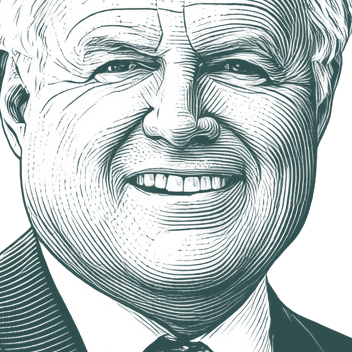
Edward Moore "Ted" Kennedy (22 February 1932 – 25 August 2009) was the senior Democratic U.S. senator from Massachusetts. In office from November 1962 to August 2009, Kennedy was, at the time, the second-longest serving member of the Senate, after Robert Byrd of West Virginia. He was the younger brother of John F. Kennedy and Robert F. Kennedy, and the uncle of Caroline Kennedy.
Portrait adapted from
Wikimedia Commons, Ted_Kennedy,_official_photo_portrait.jpg: United States Senate derivative work: Tktru (talk) (Public domain / CC0)
Also Known As
Birth Name:
Edward Moore Kennedy
Native Name:
Edward Kennedy
Alternative Names:
Edward Moore "Ted" Kennedy
•
Edward M. Kennedy
I was aware of Harry Truman’s ’48 effort to try to get universal health care, and his disappointment, and that at least [Franklin D.] Roosevelt had looked at it in the ’30s and decided to go with Social Security rather than the health issue, and that it went back to Teddy Roosevelt’s progressive period, where he tried to move it along. So I knew the concept of the issue of national health insurance. I had heard enough, having been in the Senate during the ’64 battle, and in ’65, to know that we had taken a chunk of this but we hadn’t done the whole job. I had seen the success that they had had in ’64 and ’65 and thought that this was both a great opportunity and an area of very important need.
Well I'm, umm, were I to, to make the, the announcement to run, the reasons that I would run is because I have a great belief in this country, that it is, there's more natural resources than any nation of the world, has the greatest educated population in the world the greatest technology of any country in the world, the greatest capacity for innovation in the world, and the greatest political system in the world. And yet I see at the current time that most of the industrial nations of the world are exceeding us in terms of productivity or doing better than us in terms of meeting the problems of inflation that they are dealing with, their problems of energy and their problems of unemployment. It just seems to me that this nation can cope and deal with its problems in a way that it has in the past. We are facing complex issues and problems in this nation at this time, but we have faced similar challenges at other times and the energies and the resourcefulness of this nation, I think, should be focused on these problems in a way that brings a sense of restoration in this country by its people to in dealing with the problems that we face primarily the issues on the economy, the problems of inflation, and the problems of energy and I would basically feel that that it's imperative for this country to either move forward, that it can't standstill or otherwise it moves backwards.
Go Premium
Support Quotewise while enjoying an ad-free experience and premium features.
We must continue the battle for responsible gun control, by closing the gun-show loophole, by reversing any misguided attempt to undermine the existing background-check system, and by letting the FBI review federal gun records in the investigation of terrorism and other crimes. As we work together to strengthen our immigration laws against terrorists, let us also move forward on lasting and long-overdue reforms that will benefit immigrant workers and their families, along with American business and the American economy. This is a time to stand up for freedom, to heal hurt and injustice, and most of all to serve others. The spirit of assisting others is at an all-time high in our history. It is time for a renewed national resolve to enhance national and community service, so that far more opportunities and incentives will be available for Americans to give something of themselves to help others here at home and in other lands. Effective action against international poverty must become a new national priority. We must do more -- much more -- to ease the harsh conditions in so much of the world that are breeding grounds for despair, extremism, and violence. To succeed -- not just now, but in the years ahead -- the global war on terrorism must also be a global war on poverty. This is not only a matter of moral obligation; it is an urgent, practical, indispensable element of our future national security.