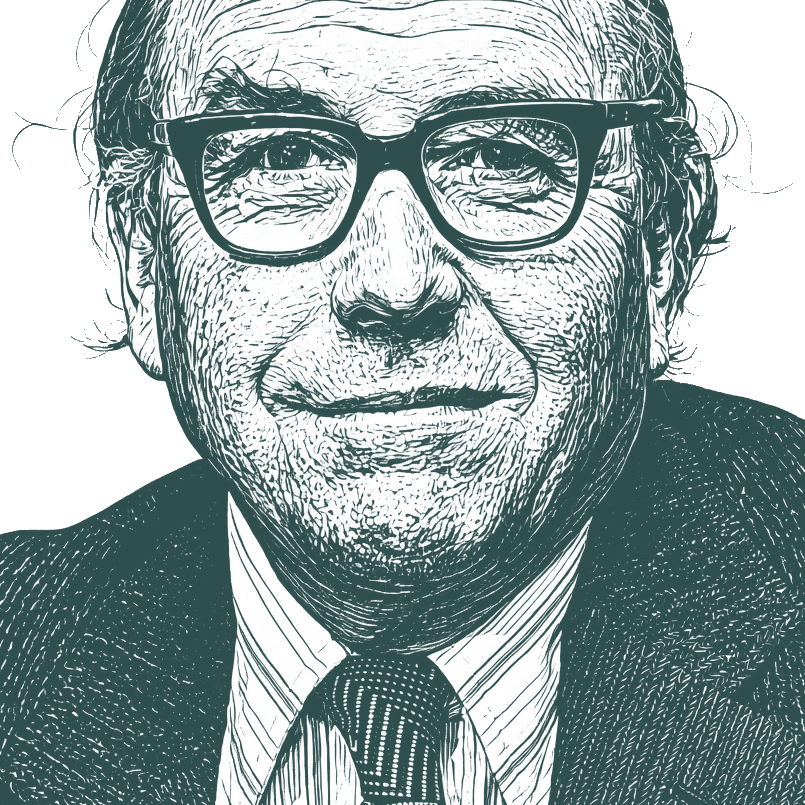
It is not some malevolent quirk of international bankers which makes the balance of payments surplus necessary. It is the hard facts of life. Quite a… - Roy Jenkins
""
It is not some malevolent quirk of international bankers which makes the balance of payments surplus necessary. It is the hard facts of life. Quite a few of the resolutions mention the need to get rid of the shackles of international finance. These shackles can be exaggerated. If you want less to do with bankers and fewer International Monetary Fund visits the answer is straightforward: Help us to get out of debt. It is no good urging independence and denying policies to that end.
Roy Harris Jenkins, Baron Jenkins of Hillhead OM PC (11 November 1920 – 5 January 2003) was a British politician who served as the sixth president of the European Commission from 1977 to 1981, having previously been one of the primary proponents of British entry into the European Economic Community. At various times a Member of Parliament (MP) for the Labour Party, Social Democratic Party (SDP) and the Liberal Democrats, he was Chancellor of the Exchequer and Home Secretary under the Wilson and Callaghan Governments. He initially identified as a democratic socialist, and later as a social democrat and centrist. As Chancellor of the Exchequer, he pursued a tight fiscal policy to control the inflation of the pound sterling. As Home Secretary, he was responsible for abolishing capital punishment and decriminalizing abortion, homosexuality, and divorce. He ran in the 1976 Labour Party leadership election to become Prime Minister, but was defeated by James Callaghan and briefly retired from British politics to serve as President of the European Commission. He returned to Britain to help found the Social Democratic Party, which formed an alliance with the Liberal Party under David Steel and was intended as a centrist alternative to the Conservative Party under Margaret Thatcher and the Labour Party under Michael Foot. However, he resigned as Party Leader after the SDP-Liberal Alliance failed to outpoll the Labour Party in the 1983 general election.
[Roy Jenkins] agreed with many of the criticisms levelled against the performance of private industry and he agreed that the country needed a sharp change. There was a case for a significant extension of public ownership. (Applause.) But public ownership must be related directly to the ordinary Labour voters and the potential Labour voters in their day to day lives, particularly in development areas, to inflation, housing, and land use. "It is no good taking over a vast number of industries without a clear plan as to how and by whom they are going to be run. It is no good pretending that a transfer of ownership in itself solves our problems."
Let us be on the side of those who want people to be free to live their own lives, to make their own mistakes, and to decide, in an adult way and provided they do not infringe the rights of others, the code by which they wish to live; and on the side of experiment and brightness, of better buildings and better food, of better music (jazz as well as Bach) and better books, of fuller lives and greater freedom. In the long run these things will be more important than the most perfect of economic policies.
Enhance Your Quote Experience
Enjoy ad-free browsing, unlimited collections, and advanced search features with Premium.
I have three great interests left in politics, a single currency, electoral reform, and the union of the Liberals with Labour. And all three are languishing.