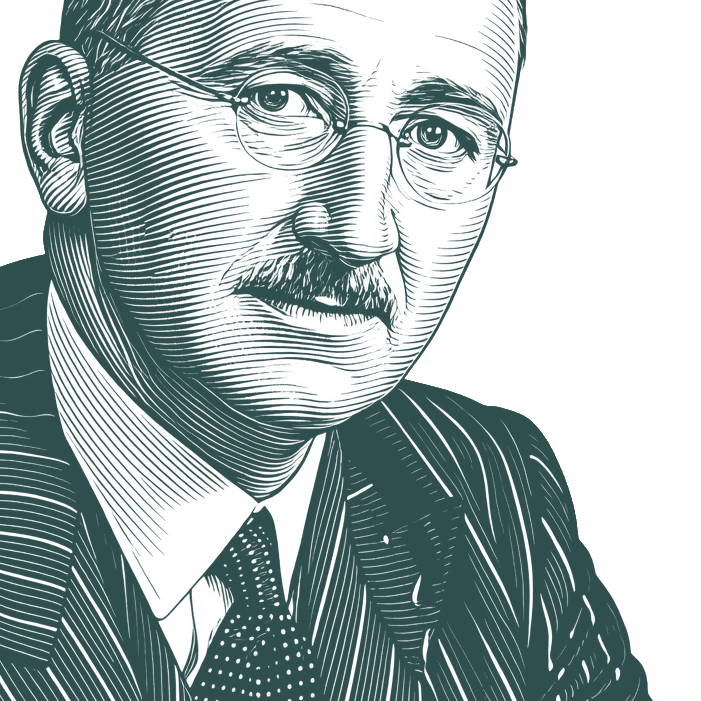
What the planning authority would have to know would not be the mere totals but the distinct, peculiar conditions prevailing in each enterprise which… - Friedrich Hayek
""
What the planning authority would have to know would not be the mere totals but the distinct, peculiar conditions prevailing in each enterprise which affect the information about values transmitted through market prices but would be completely lost in any statistical information about quantities that might reach the authority from time to time.
Friedrich August von Hayek CH (8 May 1899 – 23 March 1992) was an Austrian, later British, economist and philosopher best known for his defense of classical liberalism. In 1974, Hayek shared the (with Gunnar Myrdal) for his "pioneering work in the theory of money and economic fluctuations and … penetrating analysis of the interdependence of economic, social and institutional phenomena". (Nobel Memorial Prize, 1974)
Portrait adapted from
Wikimedia Commons, The original uploader was DickClarkMises at English Wikipedia. (CC BY-SA)
Also Known As
Native Name:
Friedrich August von Hayek
Alternative Names:
Friedrich von Hayek
•
Friedrich A. von Hayek
•
Friedrich A. Von Hayek
•
F. A. von Hayek
•
Friedrich August Von Hayek
•
Hayek
•
F. A. Hayek
Portrait from Wikimedia Commons. Credit: The original uploader was DickClarkMises at English Wikipedia.. Used under CC BY-SA. Processed and styled by Quotewise.
Unlimited Quote Collections
Organize your favorite quotes without limits. Create themed collections for every occasion with Premium.
If craftsmen and blacksmiths were feared for transforming material substance, if traders were feared for transforming such intangible qualities as value, how much more will the banker be feared for the transformations he effects with the most abstract and immaterial of all economic institutions? Thus we reach the climax of the progressive replacement of the perceivable and concrete by abstract concepts shaping rules guiding activity: money and its institutions seem to be beyond the boundary of laudable and understandable physical efforts of creation, in a realm where the comprehension of the concrete ceases and incomprehensible abstractions rule.
Both altruism and solidarity are very strong instincts which guided man in the small group. We were serving known other persons when his efforts were directed to the needs of familiar people. Now we have grown as rich as we are because we have replaced this by a system where we no longer work for the known needs of known other people, and no longer use the known assistance of other people, but where our effort is completely guided by price signals, which for the individual means that I must use my resources for the maximum success of what resources is sacrificed for the purpose, but the justification is not my benefit but in this way I benefit my fellow man most. So it does happen that so far as commercial activities economic activities are concerned we will benefit our fellow man most if we are guided solely by the striving for gain. We are then completely free how to use what we have earned and there of course the desire for being altruistic come in very strongly, but not in the ordering principle of our society.
Try QuoteGPT
Chat naturally about what you need. Each answer links back to real quotes with citations.
The attack on economics sprang rather from a dislike of the application of scientific methods to the investigation of social problems. The existence of a body of reasoning which prevented people from following their first impulsive reactions, and which compelled them to balance indirect effects, which could be seen only by exercising the intellect, against intense feeling caused by the direct observation of concrete suffering, then as now, occasioned intense resentment.