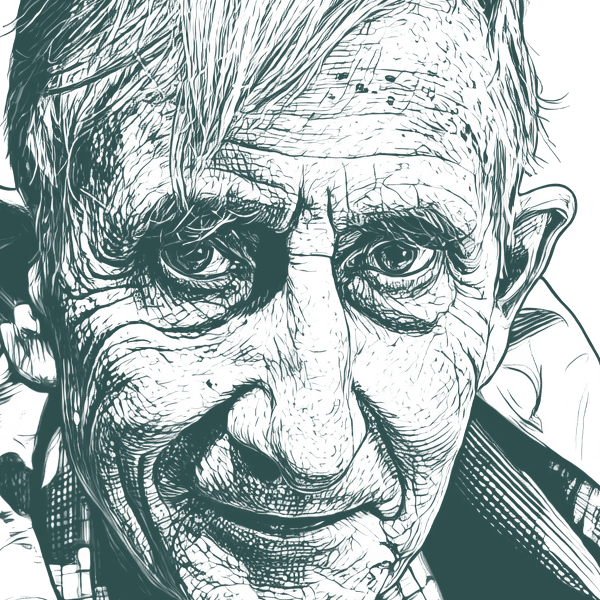
We must be careful not to discourage our twelve-year-olds by making them waste the best years of their lives preparing for examinations. - Freeman Dyson
""
We must be careful not to discourage our twelve-year-olds by making them waste the best years of their lives preparing for examinations.
Freeman John Dyson (15 December 1923 – 28 February 2020) was an English-born American physicist, mathematician, and futurist, famous for his work in quantum mechanics, nuclear weapons design and policy, and the search for extraterrestrial intelligence. He was the winner of the Templeton Prize in the year 2000.
In contrast to Kuhn, Galison in his classic work Image and Logic, published in 1997, describes the history of particle physics as a history of tools rather than ideas. According to Image and Logic, the progress of science is tool-driven. The tools of particle physics are of two kinds, optical and electronic. The optical tools are devices such as cloud chambers, bubble chambers, and photographic emulsions, which display particle interactions visually by means of images. The images record the tracks of particles. An experienced experimenter can see at once from the image when a particle is doing something unexpected. Optical tools are more likely to lead to discoveries that are qualitatively new.
On the other hand, electronic tools are better for answering quantitative questions. Electronic detectors such as the Geiger counters that measure radioactivity in the cellars of old houses are based on logic. They are programmed to ask simple questions each time they detect a particle, and to record whether the answers to the questions are yes or no. They can detect particle collisions as at rates of millions per second, sort them into yes's and no's, and count the number that answered yes and the number that answered no. The history of particle physics may be divided into two periods, the earlier period ending about 1980 when optical detectors and images were dominant, and the later period when electronic detectors and logic were dominant. Before the transition, science advanced by making qualitative discoveries of new particles and new relationships between particles. After the transition, with the zoo of known particles more or less complete, the science advanced by measuring their interactions with greater and greater precision. In both periods, before and after the transition, tools were the driving force of progress.
It is probably not an accident that modern science grew explosively in Christian Europe and left the rest of the world behind. A thousand years of theological disputes nurtured the habit of analytical thinking that could also be applied to the analysis of natural phenomena. On the other hand, the close historical relations between theology and science have caused conflicts between science and Christianity that does not exist between science and other religions.
Unlimited Quote Collections
Organize your favorite quotes without limits. Create themed collections for every occasion with Premium.
I believe global warming is grossly exaggerated as a problem. It's a real problem, but it's nothing like as serious as people are led to believe. The idea that global warming is the most important problem facing the world is total nonsense and is doing a lot of harm. It distracts people's attention from much more serious problems.