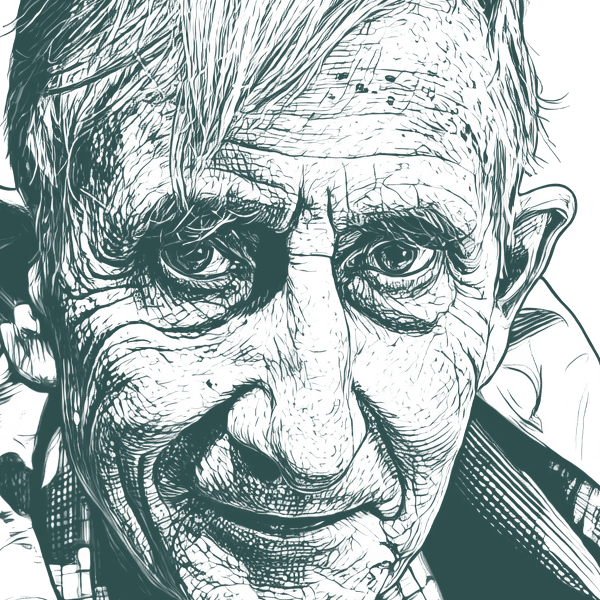
Fifty years ago Kurt Gödel... proved that the world of pure mathematics is inexhaustible. … I hope that the notion of a final statement of the laws o… - Freeman Dyson
""
Fifty years ago Kurt Gödel... proved that the world of pure mathematics is inexhaustible. … I hope that the notion of a final statement of the laws of physics will prove as illusory as the notion of a formal decision process for all mathematics. If it should turn out that the whole of physical reality can be described by a finite set of equations, I would be disappointed, I would feel that the Creator had been uncharacteristically lacking in imagination.
Freeman John Dyson (15 December 1923 – 28 February 2020) was an English-born American physicist, mathematician, and futurist, famous for his work in quantum mechanics, nuclear weapons design and policy, and the search for extraterrestrial intelligence. He was the winner of the Templeton Prize in the year 2000.
The technologies which have had the most profound effects on human life are usually simple. A good example of a simple technology with profound historical consequences is hay. Nobody knows who invented hay, the idea of cutting grass in the autumn and storing it in large enough quantities to keep horses and cows alive through the winter. All we know is that the technology of hay was unknown to the Roman Empire but was known to every village of medieval Europe. Like many other crucially important technologies, hay emerged anonymously during the so-called Dark Ages. According to the Hay Theory of History, the invention of hay was the decisive event which moved the center of gravity of urban civilization from the Mediterranean basin to Northern and Western Europe. The Roman Empire did not need hay because in a Mediterranean climate the grass grows well enough in winter for animals to graze. North of the Alps, great cities dependent on horses and oxen for motive power could not exist without hay. So it was hay that allowed populations to grow and civilizations to flourish among the forests of Northern Europe. Hay moved the greatness of Rome to Paris and London, and later to Berlin and Moscow and New York.
There is no easy solution to the conflict between fundamentalist Christian dogma and the facts of biological evolution. I am not saying that the conflict could have been altogether avoided. I am saying only that the conflict was made more bitter and more damaging, both to religion and to science, by the dogmatic and self-righteousness of scientists. What was needed was a little more human charity, a little more willingness to listen rather than to lay down the law, a little more humility. Scientists stand in need of these Christian virtues just as much as preachers do.
Euclid... gave his famous definition of a point: "A point is that which has no parts, or which has no magnitude." …A point has no existence by itself. It exists only as a part of the pattern of relationships which constitute the geometry of Euclid. This is what one means when one says that a point is a mathematical abstraction. The question, What is a point? has no satisfactory answer. Euclid's definition certainly does not answer it. The right way to ask the question is: How does the concept of a point fit into the logical structure of Euclid's geometry? ...It cannot be answered by a definition.