The winter sunset, flaming beyond spires
And chimneys half-detached from this dull sphere,
Opens great gates to some forgotten year
Of elder splendou… - H. P. Lovecraft
""
The winter sunset, flaming beyond spires And chimneys half-detached from this dull sphere, Opens great gates to some forgotten year Of elder splendours and divine desires. Expectant wonders burn in those rich fires, Adventure-fraught, and not untinged with fear; A row of sphinxes where the way leads clear Toward walls and turrets quivering to far lyres.
It is the land where beauty's meaning flowers, Where every unplaced memory has a source, Where the great river Time begins its course Down the vast void in starlit streams of hours. Dreams bring us close - but ancient lore repeats That human tread has never soiled these streets.
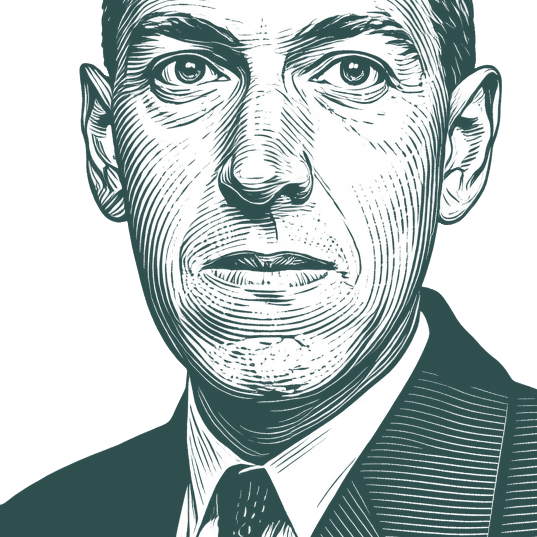
Howard Phillips Lovecraft (20 August 1890 – 15 March 1937) was an American author of fantasy, horror, and science fiction, known for combining these three genres within single narratives and best remembered for the creation of the Cthulhu Mythos. He is considered, along with Edgar Allan Poe, to be one of the greatest Horror writers.
Biography information from
Wikiquote·
Portrait adapted from
Wikimedia Commons, Lucius B. Truesdell (Public domain / CC0)
Also Known As
Pen Names:
Ward Phillips
Native Name:
Howard Phillips Lovecraft
Alternative Names:
Howard P. Lovecraft
•
HPL
•
E'ch-Pi-El
•
Grandpa Theobald
•
Lovecraft
Non è morto ciò che può vivere in eterno, E in strani eoni anche la morte può morire.
The end is near. I hear a noise at the door, as of some immense slippery body lumbering against it. It shall not find me. God, that hand! The window! The window!
Unlimited Quote Collections
Organize your favorite quotes without limits. Create themed collections for every occasion with Premium.
When I say that I can write nothing but weird fiction, I am not trying to exalt that medium but am merely confessing my own weakness. The reason I can't write other kinds is not that I don't value & respect them, but merely that my slender set of endowments does not enable me to extract a compellingly acute personal sense of interest & drama from the natural phenomena of life. I know that these natural phenomena are more important & significant than the special & tenuous moods which so absorb me, & that an art based on them is greater than any which fantasy could evoke—but I'm simply not big enough to react to them in the sensitive way necessary for artistic response & literary use. God in heaven! I'd certainly be glad enough to be a Shakespeare or Balzac or Turgeniev if I could! . . . I respect realism more than any other form of art—but must reluctantly concede that, through my own limitations, it does not form a medium which I can adequately use.