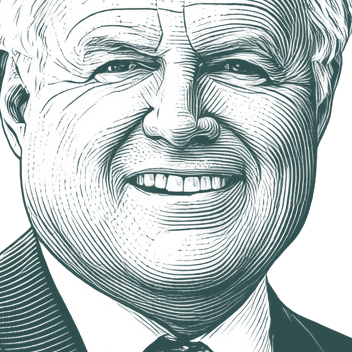
The Constitution has guided our country well for two centuries. The decision we make now goes far beyond this President. As we decide whether Preside… - Ted Kennedy
""
The Constitution has guided our country well for two centuries. The decision we make now goes far beyond this President. As we decide whether President Clinton will be removed from office, the future of the Presidency and the well-being of our democracy itself are at stake. How will history remember this Congress? The Radical Republicans in the middle of the 19th century were condemned in the eyes of history for using impeachment as a partisan vendetta against President Andrew Johnson. And I believe the Radical Republicans at the end of the 20th century will be condemned even more severely by history for their partisan vendetta against President Clinton.
Edward Moore "Ted" Kennedy (22 February 1932 – 25 August 2009) was the senior Democratic U.S. senator from Massachusetts. In office from November 1962 to August 2009, Kennedy was, at the time, the second-longest serving member of the Senate, after Robert Byrd of West Virginia. He was the younger brother of John F. Kennedy and Robert F. Kennedy, and the uncle of Caroline Kennedy.
Portrait adapted from
Wikimedia Commons, Ted_Kennedy,_official_photo_portrait.jpg: United States Senate derivative work: Tktru (talk) (Public domain / CC0)
Also Known As
Birth Name:
Edward Moore Kennedy
Native Name:
Edward Kennedy
Alternative Names:
Edward Moore "Ted" Kennedy
•
Edward M. Kennedy
The distinguished historian, Professor Arthur Schlesinger, told the House Judiciary Subcommittee on the Constitution, the "[e]vidence seems to me conclusive that the Founding Fathers saw impeachment as a remedy for grave and momentous offenses against the Constitution; George Mason said, great crimes, great and dangerous offenses, attempts to subvert the Constitution." In addition to Professor Schlesinger, over 430 law professors and over 400 historians and constitutional scholars have stated emphatically that the allegations against President Clinton do not meet the standard set by the Constitution for impeachment. The scholarly support for the argument that the charges against President Clinton do not rise to the level of impeachable offenses--even if they are true--is overwhelming, and it cannot be ignored.
Clearly, our number one priority at home -- now and in the years ahead -- is the strength of the national economy. It makes no sense for anyone in Congress or the Administration to try to blur the very obvious difference between the short run and the long run. Both are essential for our economic security, and we face major challenges on each. The most urgent short-run need is economic recovery. I strongly support Senator Daschle's plan. I believe Democrats are ready to work with the President for the kind of immediate, temporary, and fair stimulus that is essential to end this lingering recession and put our national economy back on the path of solid growth for the future. Neither side will get all it wants if we work together here. But surely we can agree to focus on the large number of laid-off workers and their families who are hurting, and who deserve help the most while they look for new jobs. Surely we can agree on the tax incentives that will actually encourage business investment now, without letting them become a transparent pretext for unaffordable longer-term tax giveaways or special interest bonanzas that the country can't afford.
PREMIUM FEATURE
Advanced Search Filters
Filter search results by source, date, and more with our premium search tools.
There was the time, shortly after the Supreme Court's decision in Roe versus Wade in 1973, when Cardinal Medeiros called Tip and asked to see him on a matter of great urgency. With some trepidation about the purpose of the visit, Tip agreed to see him right away. As it turned out, Cardinal Medeiros was extremely concerned about a powerful hurricane that had just devastated the Cape Verde Islands. He had a specific request for Tip--to see if $8 million in emergency relief could be included in the foreign aid appropriations bill. Tip, with that irrepressible twinkle in his eye, replied, "Your Eminence, I'll put $16 million in, if you won't mention Roe versus Wade." One of Tip's most famous stories concerned the gift by Henry Ford of $5,000 toward a new hospital in Ireland. Unfortunately, the local newspaper the next day reported that the gift was $50,000. The editor apologized profusely for the mistake, and said he'd run a correction right away, explaining that the gift was only $5,000. It took Henry Ford about 10 seconds to realize what was happening, and he said, "No, don't do that. I'll give you the $50,000, but on one condition--that you put a plaque over the entrance to the hospital with this inscription--'I came unto you, and you took me in.'"