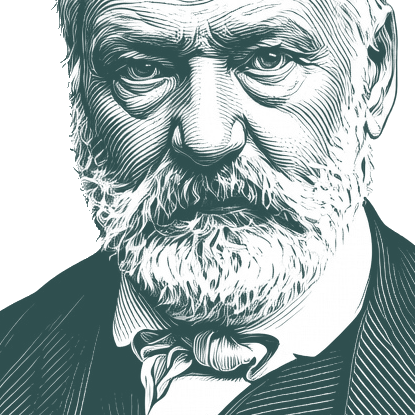
A people, like stars, are entitled to eclipse. All is well, provided the light returns and the eclipse does not become endless night. Dawn and resurr… - Victor Hugo

" "

A people, like stars, are entitled to eclipse. All is well, provided the light returns and the eclipse does not become endless night. Dawn and resurrection are synonymous. The reappearance of the light is the same as the survival of the soul.

English
Collect this quote

About Victor Hugo

Victor Marie Hugo (26 February 1802 – 22 May 1885) was a French poet, novelist, and dramatist of the Romantic movement, widely esteemed as one of the greatest of French writers and poets.

Biography information from Wikiquote

Also Known As

Alternative Names: Victor Marie Hugo Homme océan Ocean Man Victor-Marie Hugo
Enhance Your Quote Experience

Enjoy ad-free browsing, unlimited collections, and advanced search features with Premium.

Related quotes. More quotes will automatically load as you scroll down, or you can use the load more buttons.

Additional quotes by Victor Hugo

Relegated as he was to a corner and as though sheltered behind the billiard table, the soldiers, their eyes fixed upon Enjolras, had not even noticed Grantaire, and the sergeant was preparing to repeat the order: 'Take aim!' when suddenly they heard a powerful voice cry out beside them, 'Vive la Republique! Count me in.'
Grantaire was on his feet.
The immense glare of the whole combat he had missed and in which he had not been, appeared in the flashing eyes of the transfigured drunkard.
He repeated, 'Vive la Republique!' crossed the room firmly, and took his place in front of the muskets beside Enjolras.
'Two at one shot,' he said.
And, turning toward Enjolras gently, he said to him, 'Will you permit it?'
Enjolras shook his hand with a smile.
The smile had not finished before the report was heard.
Enjolras, pierced by eight bullets, remained backed up against the wall is if the bullets had nailed him there. Except that his head was tilted.
Grantaire, struck down, collapsed at his feet.

Behold, then, a new religion, a new society; upon this twofold foundation there must inevitably spring up a new poetry. Previously following therein the course pursued by the ancient polytheism and philosophy, the purely epic muse of the ancients had studied nature in only a single aspect, casting aside without pity almost everything in art which, in the world subjected to its imitation, had not relation to a certain type of beauty. A type which was magnificent at first, but, as always happens with everything systematic, became in later times false, trivial and conventional. Christianity leads poetry to the truth. Like it, the modern muse will see things in a higher and broader light. It will realize that everything in creation is not humanly beautiful, that the ugly exists beside the beautiful, the unshapely beside the graceful, the grotesque on the reverse of the sublime, evil with good, darkness with light. It will ask itself if the narrow and relative sense of the artist should prevail over the infinite, absolute sense of the Creator; if it is for man to correct God; if a mutilated nature will be the more beautiful for the mutilation; if art has the right to duplicate, so to speak, man, life, creation; if things will progress better when their muscles and their vigour have been taken from them; if, in short, to be incomplete is the best way to be harmonious. Then it is that, with its eyes fixed upon events that are both laughable and redoubtable, and under the influence of that spirit of Christian melancholy and philosophical criticism which we described a moment ago, poetry will take a great step, a decisive step, a step which, like the upheaval of an earthquake, will change the whole face of the intellectual world. It will set about doing as nature does, mingling in its creations — but without confounding them — darkness and light, the grotesque and the sublime; in other words, the body and the soul, the beast and the intellect; for the starting-point of religion is always the starting-point of poetry. All things are connected. Thus, then, we see a principle unknown to the ancients, a new type, introduced in poetry; and as an additional element in anything modifies the whole of the thing, a new form of the art is developed. This type is the grotesque; its new form is comedy.

Try QuoteGPT

Chat naturally about what you need. Each answer links back to real quotes with citations.

Loading...