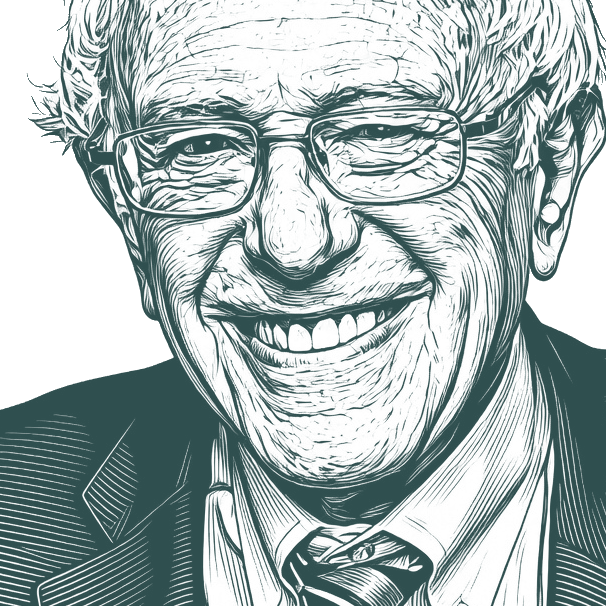
Well, our hearts go out to everyone. We need to move aggressively to make sure that every person in this country who has the virus, who thinks they h… - Bernie Sanders
""
Well, our hearts go out to everyone. We need to move aggressively to make sure that every person in this country who has the virus, who thinks they have the virus, understands they get all the health care that they need, because they are Americans, that we move aggressively to make sure that the test kits are out there, that the ventilators are out there, that the ICU units are out there, that the medical personnel are out there. But, Jake, if I might also say, that in this moment of economic uncertainty, in addition to the coronavirus, it is time to ask how we get to where we are, not only our lack of preparation for the virus, but how we end up with an economy where so many of our people are hurting at a time of massive income and wealth inequality. It is time to ask this -- the question of where the power is in America. Who owns the media? Who owns the economy? Who owns the legislative process? Why do we give tax breaks to billionaires and not raise the minimum wage? Why do we pump up the oil industry while a half-a- million people are homeless in America? This is a time to move aggressively, dealing with the coronavirus crisis, to deal with the economic fallout. But it's also a time to rethink America and create a country where we care about each other rather than a nation of greed and corruption, which is what is taking place among the corporate elite.
Bernard Sanders (born September 8, 1941) is an American politician who has served as the junior from Vermont since 2007. The for the state's at-large congressional district from 1991 to 2007, he is the longest-serving independent in U.S. congressional history and a member of the Democratic caucus. Sanders ran unsuccessfully for the 2016 and 2020 Democratic nomination for president.
Portrait adapted from
Wikimedia Commons, Palácio do Planalto from Brasilia, Brasil (CC BY)
Also Known As
Birth Name:
Bernard Sanders
Alternative Names:
Sen. Bernie Sanders
•
Bernie
•
Bernard "Bernie" Sanders
•
Senator Bernie Sanders
•
Senator Sanders
Our country faces unprecedented challenges today. They cannot be resolved with half-steps or compromises. There is not a middle ground between the insatiable greed of uber-capitalism and a fair deal for the working class. There is not a middle ground as to whether or not we save the planet. There is not a middle ground about whether or not we preserve our democracy and remain a society based on equal protection for all. Democrats face the most fundamental of all choices. They must choose whether to be on the side of the working class men and women who create the wealth of this country, or to be on the side of the billionaire class, and the wealthy campaign donors who hoard wealth for their own self-interest. By making unequivocal decisoon as to which side they are on in the class war, Democrats can finally enact policies to overcome uber-capitalism and the greed, inequality, and bigorty that have denied this country the promise of "liberty and justice for all." This is the stuff of a political revolution. A political revolution that every poll tells us the American people want. The danger for the Democratic Party is not being too bold. It's being too cautious. It's time, finally, for the Democrats to recignize that good policy is good politics. It's good for the country. It's good for the world. Let's do it!
I am disappointed by the president's decision to continue pushing forward on the disastrous trade agreement that will cost American jobs, harm the environment, increase the cost of prescription drugs and threaten our ability to protect public health. This treaty is opposed by every trade union in the country and virtually the entire grassroots base of the Democratic Party. ... Secretary Clinton made her strongest statement to date against this deal. In my view, it is now time for the leadership of the Democratic Party in the Senate and the House to join Secretary Clinton and go on the record in opposition to holding a vote on this job-killing trade deal during the lame-duck session of Congress and beyond. We need to defeat this treaty and fundamentally rewrite our trade policies to create good-paying jobs in this country and throughout the world and end the race to the bottom. I will continue to do everything I can to make sure that the TPP does not get implemented.
Works in ChatGPT, Claude, or Any AI
Add semantic quote search to your AI assistant via MCP. One command setup.
Now, if Medicare for All was so great, you might ask, why hasn’t it been enacted by now? Why hasn’t the United States joined every major country on earth in guaranteeing health care for all? Well, the answer is pretty simple. Follow the money. Since 1998, in our corrupt political system, the private health care sector has spent more than $10.6 billion on lobbying and over the last 30 years it has spent more than $1.7 billion on campaign contributions to maintain the status quo. And, by the way, they are "bi-partisan." In fact, they own many of the politicians in both the Democratic and Republican parties. Guaranteeing health care as a right is important to the American people not just from a moral and financial perspective; it also happens to be what the majority of the American people want. In 2020, in a Hill/Harris poll 69 percent of the American people supported providing Medicare to every American. Now is the time for Congress to stand with the American people and take on the powerful special interests that dominate health care in the United States. Now is the time to improve and extend Medicare to everyone. Here is the bottom line: If every major country on earth can guarantee health care to all and achieve better health outcomes, while spending substantially less per capita than we do, there is no reason, other than greed, that the United States of America cannot do the same.