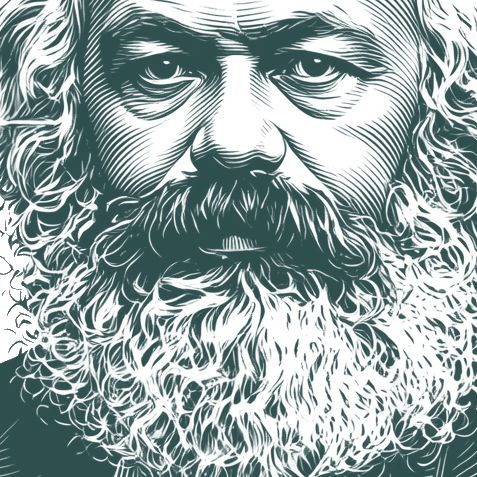
What do you think of the aspect of the money market? … This time, by the by, the thing has assumed European dimensions such as have never been seen b… - Karl Marx
""
What do you think of the aspect of the money market? … This time, by the by, the thing has assumed European dimensions such as have never been seen before, and I don't suppose we'll be able to spend much longer here merely as spectators. The very fact that I've at last got round to setting up house again and sending for my books seems to me to prove that the 'mobilisation' of our persons is <small>AT HAND</small>.
Karl Heinrich Marx (5 May 1818 – 14 March 1883) was a German political philosopher, economist, historian, sociologist, journalist and revolutionary socialist. Marx's work in economics laid the basis for labor theory of value, and has influenced much of subsequent economic thought. He published many works during his lifetime, including The Communist Manifesto (1848) and the first volume of Das Kapital (1867), the two later volumes being completed by his collaborator Friedrich Engels.
Biography information from
Wikiquote·
Portrait adapted from
Wikimedia Commons, John Jabez Edwin Mayall (Public domain / CC0)
Also Known As
Pen Names:
Glückskind
Alternative Names:
Karl Heinrich Marx
•
Karl H. Marx
•
Marx
So far as living instruments of labour are concerned, for instance horses, their reproduction is timed by nature itself. Their average lifetime as instruments of labour is determined by the laws of nature. As soon as this term has expired they must be replaced by new ones. A horse cannot be replaced piecemeal; it must be replaced by another horse.
In money-lenders’ capital the form M-C-M is reduced to the two extremes without a mean, M-M , money exchanged for more money, a form that is incompatible with the nature of money, and therefore remains inexplicable from the standpoint of the circulation of commodities. Hence Aristotle: “since chrematistic is a double science, one part belonging to commerce, the other to economic, the latter being necessary and praiseworthy, the former based on circulation and with justice disapproved (for it is not based on Nature, but on mutual cheating), therefore the usurer is most rightly hated, because money itself is the source of his gain, and is not used for the purposes for which it was invented.
Limited Time Offer
Premium members can get their quote collection automatically imported into their Quotewise collections.