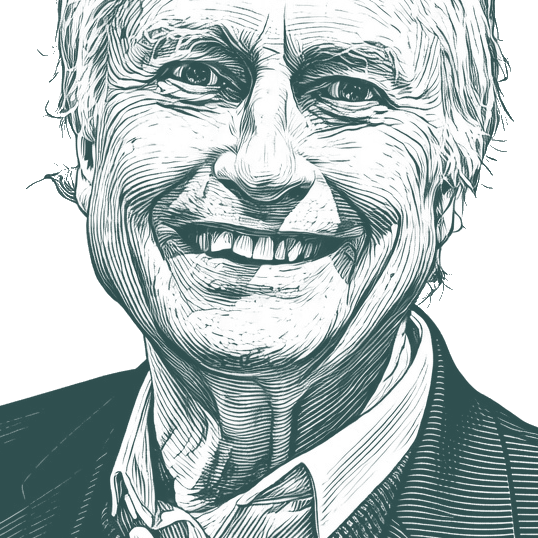
As Einstein said, 'If people are good only because they fear punishment, and hope for reward, then we are a sorry lot indeed. ' Michael Shermer, In T… - Richard Dawkins
""
As Einstein said, 'If people are good only because they fear punishment, and hope for reward, then we are a sorry lot indeed. ' Michael Shermer, In The Science of Good and Evil, calls it a debate stopper. If you agree that, in the absence of God, you would 'commit robbery, rape, and murder', you reveal yourself as an immoral person, 'and we would be well advised to steer a wide course around you'. If, on the other hand, you admit that you would continue to be a good person even when not under divine surveillance, you have fatally undermined your claim that God is necessary for us to be good.
English
Collect this quote
About
Richard Dawkins
Richard Dawkins (born 26 March 1941) is a British evolutionary biologist and author. He is known for his advocacy of atheism.
We've reached a truly remarkable situation: a grotesque mismatch between the American intelligentsia and the American electorate. A philosophical opinion about the nature of the universe which is held by the vast majority of top American scientists, and probably the majority of the intelligentsia generally, is so abhorrent to the American electorate that no candidate for popular election dare affirm it in public. If I'm right, this means that high office in the greatest country in the world is barred to the very people best qualified to hold it: the intelligentsia, unless they are prepared to lie about their beliefs. To put it bluntly American political opportunities are heavily loaded against those who are simultaneously intelligent and honest.
Science replaces private prejudice with public, verifiable evidence.
Go Premium
Support Quotewise while enjoying an ad-free experience and premium features.
To be fair, much of the Bible is not systematically evil but just plain weird, as you would expect of a chaotically cobbled-together anthology of disjointed documents, composed, revised, translated, distorted and 'improved' by hundreds of anonymous authors, editors and copyists, unknown to us and mostly unknown to each other, spanning nine centuries