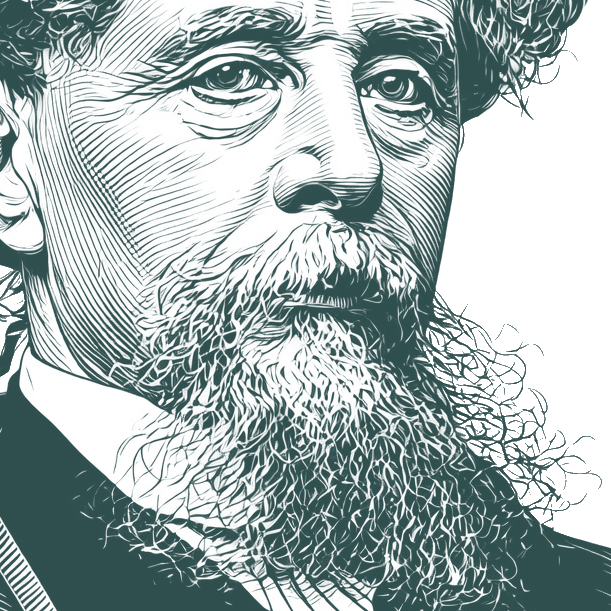
Charles John Huffam Dickens, FRSA (7 February 1812 – 9 June 1870) was the foremost English novelist of the Victorian era, as well as a vigorous social campaigner. Charles Dickens was trying to ban workhouses his whole career.
Biography information from
Wikiquote·
Portrait adapted from
Wikimedia Commons, Jeremiah Gurney (Public domain / CC0)
"The purpose was, that I would go to Biddy, that I would show her how humbled and repentant I came back, that I would tell her how I had lost all I once hoped for, that I would remind her of our old confidences in my first unhappy time. Then, I would say to her, "Biddy, I think you once liked me very well, when my errant heart, even while it strayed away from you, was quieter and better with you than it ever has been since. If you can like me only half as well once more, if you can take me with all my faults and disappointments on my head, if you can receive me like a forgiven child (and indeed I am so sorry, Biddy, and have as much need of a hushing voice and a soothing hand), I hope I am a little worthier of you than I was — not much, but a little. And Biddy, it shall rest with you to say whether I shall work at the forge with Joe, or whether I shall try for any different occupation down in this country, or whether we shall go away to a distant place where an opportunity awaits me, which I set aside when it was offered, until I knew your answer. And now, dear Biddy, if you can tell me that you will go through the world with me, you will surely make it a better world for me, and me a better man for it, and I will try hard to make it a better world for you.
Think now and then that there is a man who would give his life, to keep a life you love beside you.
Go Premium
Support Quotewise while enjoying an ad-free experience and premium features.