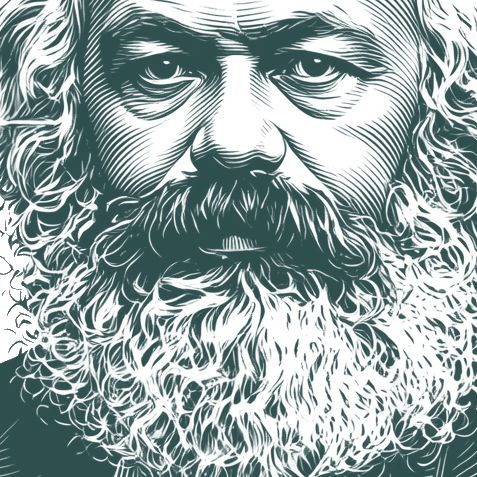
Everyone has a goal which appears to be great, at least to himself, and is great when deepest conviction, the innermost voice of the heart, pronounce… - Karl Marx
""
Everyone has a goal which appears to be great, at least to himself, and is great when deepest conviction, the innermost voice of the heart, pronounces it great. … This voice, however, is easily drowned out, and what we thought to be inspiration may have been created by the fleeting moment and again perhaps destroyed by it. … We must seriously ask ourselves, therefore, whether we are really inspired about a vocation, whether an inner voice approves of it, or whether the inspiration was a deception, whether that which we took as the Deity's calling to us was self-deceit. But how else could we recognize this except by searching for the source of our inspiration?
Karl Heinrich Marx (5 May 1818 – 14 March 1883) was a German political philosopher, economist, historian, sociologist, journalist and revolutionary socialist. Marx's work in economics laid the basis for labor theory of value, and has influenced much of subsequent economic thought. He published many works during his lifetime, including The Communist Manifesto (1848) and the first volume of Das Kapital (1867), the two later volumes being completed by his collaborator Friedrich Engels.
Biography information from
Wikiquote·
Portrait adapted from
Wikimedia Commons, John Jabez Edwin Mayall (Public domain / CC0)
Also Known As
Pen Names:
Glückskind
Alternative Names:
Karl Heinrich Marx
•
Karl H. Marx
•
Marx
It [bourgeoisie] has resolved personal worth into exchange value, and in place of the numberless indefeasible chartered freedoms, has set up that single, unconscionable freedom – Free Trade.
When communist workmen associate with one another, theory, propaganda, etc., is their first end. But at the same time, as a result of this association, they acquire a new need - the need for society - and what appears as a means becomes an end. You can observe this practical processing its most splendid results whenever you see French socialist workers together. Such things as smoking, drinking, eating, etc., are no longer means of contact or means that bring together. Company, association, and conversation, which again has society as its end, are enough for them; the brotherhood of man is on mere phase with them, but a fact of life, and the nobility of man shines upon us from their work-hardened bodies.
Enhance Your Quote Experience
Enjoy ad-free browsing, unlimited collections, and advanced search features with Premium.