Enhance Your Quote Experience
Enjoy ad-free browsing, unlimited collections, and advanced search features with Premium.
" "There is no steady unretracing progress in this life; we do not advance through fixed gradations, and at the last one pause: — through infancy's unconscious spell, boyhood's thoughtless faith, adolescence' doubt (the common doom), then scepticism, then disbelief, resting at last in manhood's pondering repose of If. But once gone through, we trace the round again; and are infants, boys, and men, and Ifs eternally. Where lies the final harbor, whence we unmoor no more? In what rapt ether sails the world, of which the weariest will never weary? Where is the foundling's father hidden? Our souls are like those orphans whose unwedded mothers die in bearing them: the secret of our paternity lies in their grave, and we must there to learn it.
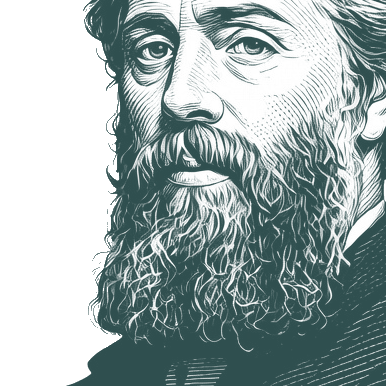
Herman Melville (1 August 1819 – 28 September 1891) was an American novelist, essayist, short story writer, and poet of the American Renaissance period.
Biography information from Wikiquote
Enjoy ad-free browsing, unlimited collections, and advanced search features with Premium.
Related quotes. More quotes will automatically load as you scroll down, or you can use the load more buttons.
But the mingled, mingling threads of life are woven by warp and woof: calms crossed by storms, a storm for every calm. There is no steady unretracing progress in this life; we do not advance through fixed gradations, and at the last one pause: — through infancy’s unconscious spell, boyhood’s thoughtless faith, adolescence’ doubt (the common doom), then scepticism, then disbelief, resting at last in manhood’s pondering repose of If. But once gone through, we trace the round again; and are infants, boys, and men, and Ifs eternally.
As I sat there in that now lonely room; the fire burning low, in that mild stage when, after its first intensity has warmed the air, it then only glows to be looked at; the evening shades and phantoms gathering round the casements, and peering in upon us silent, solitary twain; thw storm booming without in solemn swells; I began to be sensible of strange feelings. I felt a melting in me. No more my splintered heart and maddened hand were turned against the wolfish world. This soothing savage had redeemed it. There he sat, his very indifference speaking a nature in which there lurked no civilized hypocrisies and bland deceits. Wild he was; a very sight of sights to see; yet I began to feel myself mysteriously drawn towards him. And those same things that would have repelled most others, they were the very magnets that thus drew me. I'll try a pagan friend, though I, since Christian kindness has proved but hollow courtesy.
I cannot tell you how thankful I am for your reminding me about the apocrypha here. For the moment, its being such escaped me. Fact is, when all is bound up together, it's sometimes confusing. The uncanonical part should be bound distinct. And, now that I think of it, how well did those learned doctors who rejected for us this whole book of Sirach. I never read anything so calculated to destroy man's confidence in man. This son of Sirach even says — I saw it but just now: 'Take heed of thy friends'; not, observe, thy seeming friends, thy hypocritical friends, thy false friends, but thy friends, thy real friends — that is to say, not the truest friend in the world is to be implicitly trusted. Can Rochefoucault equal that? I should not wonder if his view of human nature, like Machiavelli's, was taken from this Son of Sirach. And to call it wisdom — the Wisdom of the Son of Sirach! Wisdom, indeed! What an ugly thing wisdom must be! Give me the folly that dimples the cheek, say I, rather than the wisdom that curdles the blood. But no, no; it ain't wisdom; it's apocrypha, as you say, sir. For how can that be trustworthy that teaches distrust?"